
Author : Evermethod, Inc. | February 9, 2026
.png/preview.png?t=1721195409615)

Most large enterprises have moved beyond isolated AI pilots. Models are now embedded in pricing, risk assessment, demand forecasting, customer interaction, and operational planning. Despite this progress, many organizations struggle to scale AI beyond narrow use cases.
The limiting factor is rarely algorithmic performance. Instead, AI initiatives surface constraints embedded in existing enterprise architectures.
Traditional digital systems were designed to execute predefined logic. They assume stable inputs, predictable behavior, and clear separation between build time and run time. AI systems violate these assumptions. They introduce uncertainty, evolve through learning, and influence decisions that carry material business consequences.
When AI is deployed on top of architectures built for deterministic execution, enterprises encounter friction in data flow, deployment cycles, system ownership, and accountability. AI-native architecture is emerging as a response to this structural mismatch.
1. What AI-Native Means in Architectural Terms
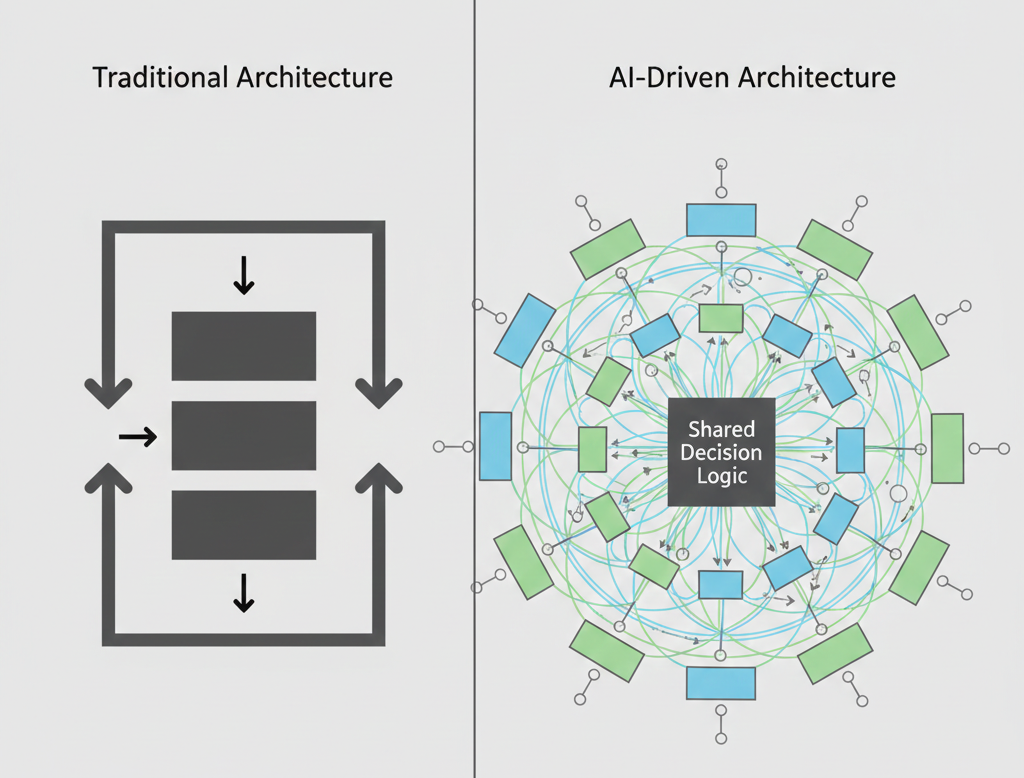
AI-native architecture refers to a set of design assumptions rather than a technology stack.
An AI-native enterprise assumes from the outset that intelligence will be embedded into how decisions are made and executed. This leads to fundamentally different architectural choices.
Key assumptions include:
- Decisions will be influenced by probabilistic models
- Models will change based on new data and outcomes
- Human judgment will remain necessary in critical scenarios
- Learning will be continuous rather than episodic
These assumptions reshape system boundaries.
|
Dimension |
Conventional Architecture |
AI-Native Architecture |
|
Core logic |
Embedded in applications |
Exposed as decision services |
|
Change model |
Scheduled releases |
Continuous adaptation |
|
Behavior |
Predictable |
Probabilistic |
|
Accountability |
System ownership |
Decision ownership |
AI-native architecture is therefore defined by how systems behave over time, not by the presence of AI components.
2. Why the Shift Is Accelerating Now
Several developments have made AI-native design unavoidable.
Enterprises face increasing pressure to act on signals faster. Customer behavior, supply conditions, and market dynamics change in near real time. Rule-based automation cannot absorb this variability without constant manual intervention.
At the same time, AI models increasingly influence outcomes that matter financially, operationally, and legally. This raises expectations for traceability, explainability, and oversight.
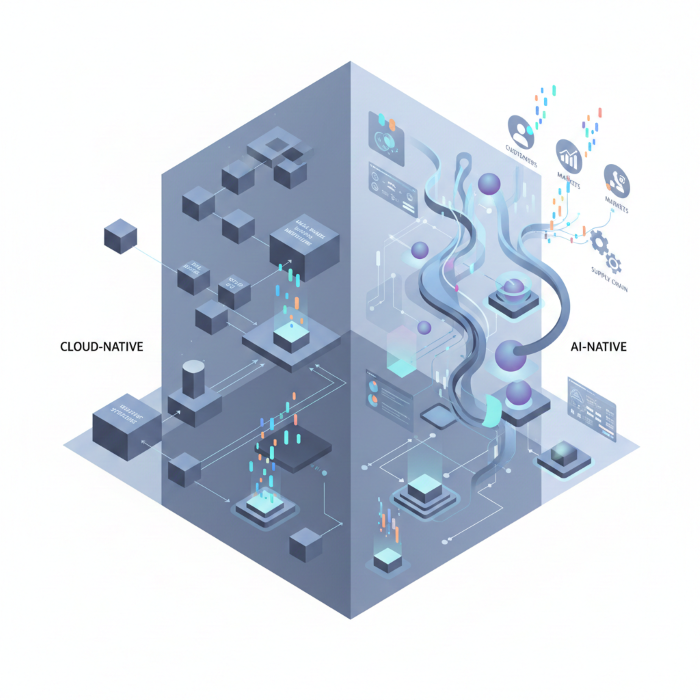
Cloud-native architecture addressed scalability and availability. It did not address learning systems, adaptive behavior, or decision accountability. AI-native architecture fills this gap by treating intelligence and learning as first-class design concerns.
3. Core Technical Components of AI-Native Architecture
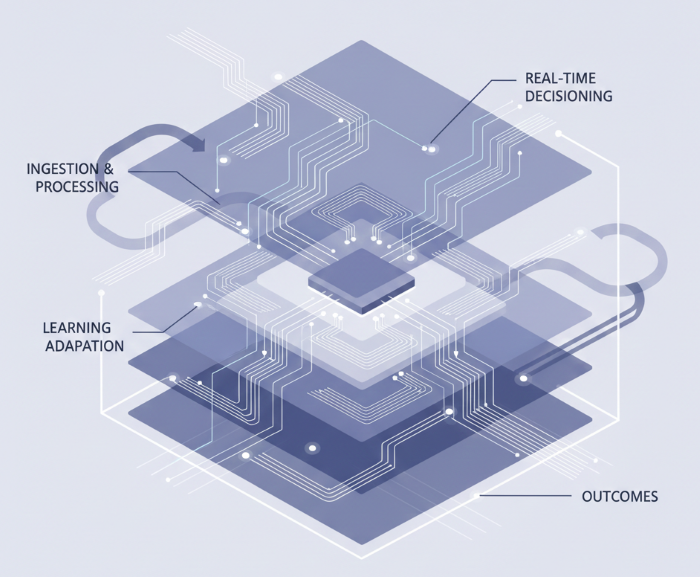
3.1 Data Architecture Designed for Learning
AI-native systems treat data as a continuous input to decision-making rather than a static resource.
This requires architectural changes:
- Event-driven and streaming pipelines replace batch-only ingestion
- Data must be accessible for both real-time inference and ongoing training
- Feature stores are managed as shared, governed assets
- Lineage and observability are built into pipelines by default
- Feedback from outcomes is captured and reused
Data quality is no longer assessed periodically. It is monitored continuously as part of system operation.
3.2 Model Lifecycle as a Platform Responsibility
In AI-native environments, models are not deployed once and left unchanged.
Architectural support is required for:
- Continuous training and evaluation
- Versioning of models and associated data
- Safe deployment and rollback in production
- Managing dependencies between models and downstream decisions
This shifts MLOps from a team-level concern to an enterprise platform capability. Without this shift, model sprawl and operational risk increase rapidly.
3.3 Decision-Centric System Design
One of the most significant changes in AI-native architecture is the separation of decisions from workflows.
Instead of embedding logic inside processes, decisions are exposed as services with clear contracts.
A decision service typically defines:
- Required inputs and data sources
- The model or logic used
- Confidence or risk thresholds
- Escalation and override rules
This approach allows decisions to be reused across products and channels, supports consistent governance, and clarifies accountability for AI-influenced outcomes.
3.4 Human-AI Interaction as a System Layer
AI-native architecture does not assume full automation.
Human interaction is explicitly designed into the system:
- AI outputs are delivered at points where action is taken
- Interfaces allow users to compare options and challenge recommendations
- Different roles see different levels of abstraction
- Overrides and feedback are captured as learning signals
Treating human judgment as a system component improves both trust and performance over time.
4. Operating Model Implications of AI-Native Architecture
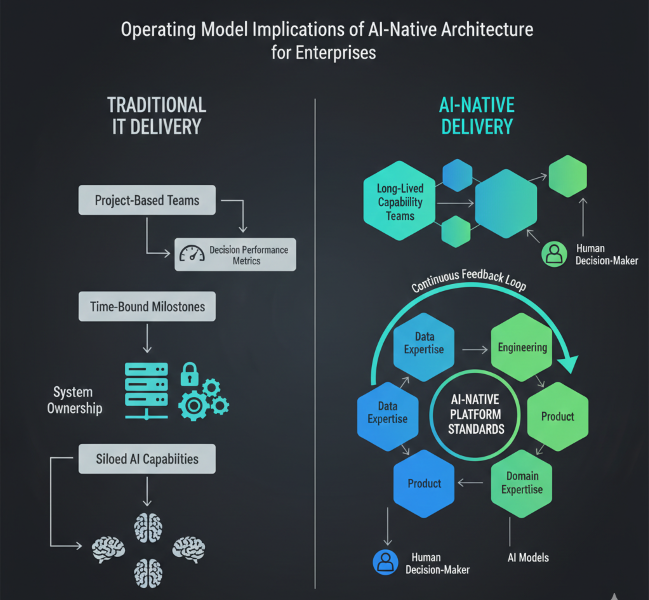
AI-native architecture fundamentally changes how work is organized, governed, and sustained. Without operating model change, architectural gains degrade quickly.
From Systems to Decision Capabilities
Traditional operating models organize teams around applications or platforms. AI-native systems organize around decision capabilities.
A decision capability includes:
- The data required to inform a decision
- The models that influence it
- The human roles accountable for outcomes
- The metrics used to evaluate performance over time
This capability persists even as models, data sources, and interfaces change.
Shifting Accountability
In legacy environments, accountability often ends at system availability. In AI-native environments, availability is necessary but insufficient.
Accountability expands to include:
- Quality and consistency of decisions
- Stability of outcomes under changing conditions
- Appropriateness of human intervention
- Long-term learning behavior of the system
This requires clearer ownership models than many enterprises currently have.
Changes to Team Structure
AI-native systems do not align well with project-based delivery.
|
Dimension |
Traditional Delivery |
AI-Native Delivery |
|
Structure |
Temporary project teams |
Long-lived capability teams |
|
Success measure |
On-time delivery |
Decision performance |
|
Change ownership |
IT or engineering |
Cross-functional |
Teams often include engineering, data, product, and domain expertise. Their mandate is not to deliver once, but to continuously improve decision outcomes.
Centralization vs Coherence
Early AI efforts often rely on centralized teams to establish standards and capability. At scale, this model breaks down.
AI-native enterprises move toward:
- Distributed ownership of decisions
- Centralized platforms for data, models, and governance
- Shared architectural standards rather than centralized execution
This balance allows local adaptation without fragmentation.
Incentives and Measurement
Operating models must reinforce learning.
Incentives shift away from output metrics toward outcome metrics, such as:
- Improvement in decision accuracy over time
- Reduction in unnecessary human escalation
- Stability of outcomes across scenarios
- Speed of adaptation to new signals
Without aligned incentives, teams optimize for delivery rather than learning.
5. Transitioning From Legacy Architectures
Most enterprises cannot adopt AI-native architecture through wholesale replacement. Legacy systems often support revenue-critical processes, regulatory obligations, and deeply embedded integrations. Attempting a full rebuild introduces unacceptable operational risk.
Successful transitions therefore focus on architectural evolution rather than replacement. The goal is to introduce AI-native principles incrementally while reducing long-term dependency on deterministic, tightly coupled systems. Few enterprises can move directly to an AI-native architecture.
Effective transitions are incremental and selective.
Common patterns include:
- Starting with decision-heavy domains such as pricing, risk, or planning
- Introducing AI-native decision services alongside legacy workflows
- Gradually replacing embedded logic with reusable decision components
- Avoiding early modernization of tightly coupled transaction systems
Progress is measured by reduced friction and increased reuse rather than by the number of systems replaced.
Conclusion
AI-native architecture is becoming the default foundation for enterprises that expect AI to influence decisions in a sustained and accountable way.
The challenge is not access to models or tools. It is the ability to design systems that combine intelligence, governance, and human judgment without creating fragility.
Enterprises that address architecture directly are better positioned to scale AI beyond isolated use cases and into core operations.
A Practical Next Step
Designing AI-native architecture is not a technology procurement exercise. It requires coordinated change across system design, operating models, and leadership accountability.
Evermethod Inc works with enterprises to:
- Identify architectural constraints limiting AI impact
- Design AI-native decision and operating architectures
- Align technical foundations with governance and executive responsibility
When AI initiatives stall, architecture is often the root cause.
Evermethod along with its partner companies helps organizations designs and develops AI solutions. . Contact us today to know more.
%2013.png)