
Author : Evermethod, Inc. | December 15, 2025
.png/preview.png?t=1721195409615)

1. The Criticality of Modernization in the AI Era
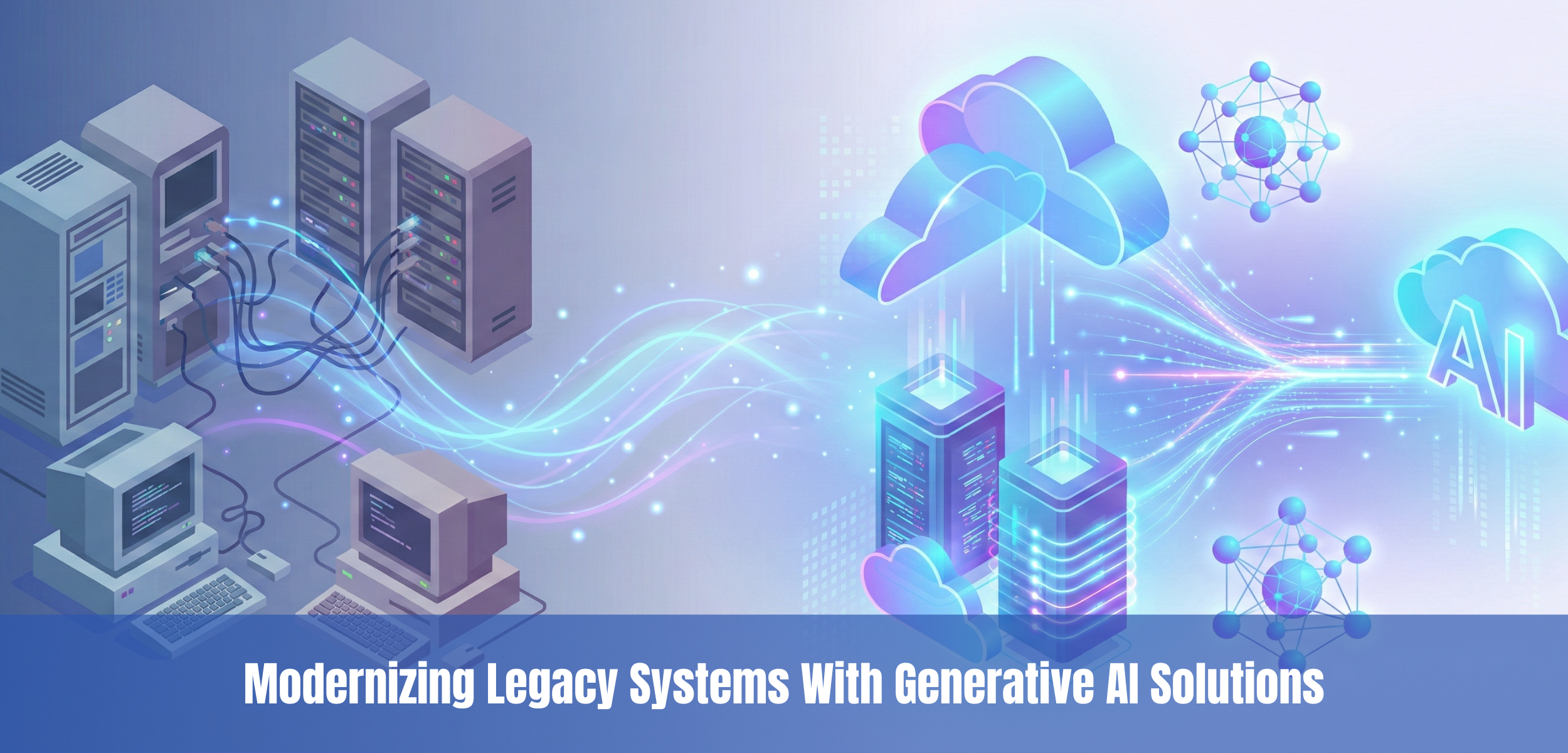
The Legacy Dilemma

For decades, many organizations have relied on core operational systems. These are typically monolithic architectures, built in older languages like COBOL, running on outdated infrastructure. While they once represented innovation, they now pose profound strategic handicaps: crippling maintenance costs, exposure to mounting security threats, poor scalability, and a cripplingly slow response to market changes.
This enduring challenge has created a significant divide between an organization's core processes and the modern requirements of the digital economy, such as microservices, cloud elasticity, and real-time data flow.
Generative AI as the Catalyst for Change
The conventional methods for modernizing these systems, manual rewrites and gradual replacement are notoriously slow, risky, and resource-intensive. However, the emergence of Generative AI (GenAI), particularly advanced Large Language Models (LLMs) and Code Generation Models, offers an entirely new path.
GenAI is not merely an efficiency tool; it is a non-linear accelerator for modernization. It provides the means for automated, precise system discovery, comprehensive code transformation, and rigorous quality assurance. This capability fundamentally reduces the risk and time associated with the massive-scale modernization projects that were previously too daunting to attempt.
2. The Technical Foundations: GenAI in the Modernization Lifecycle
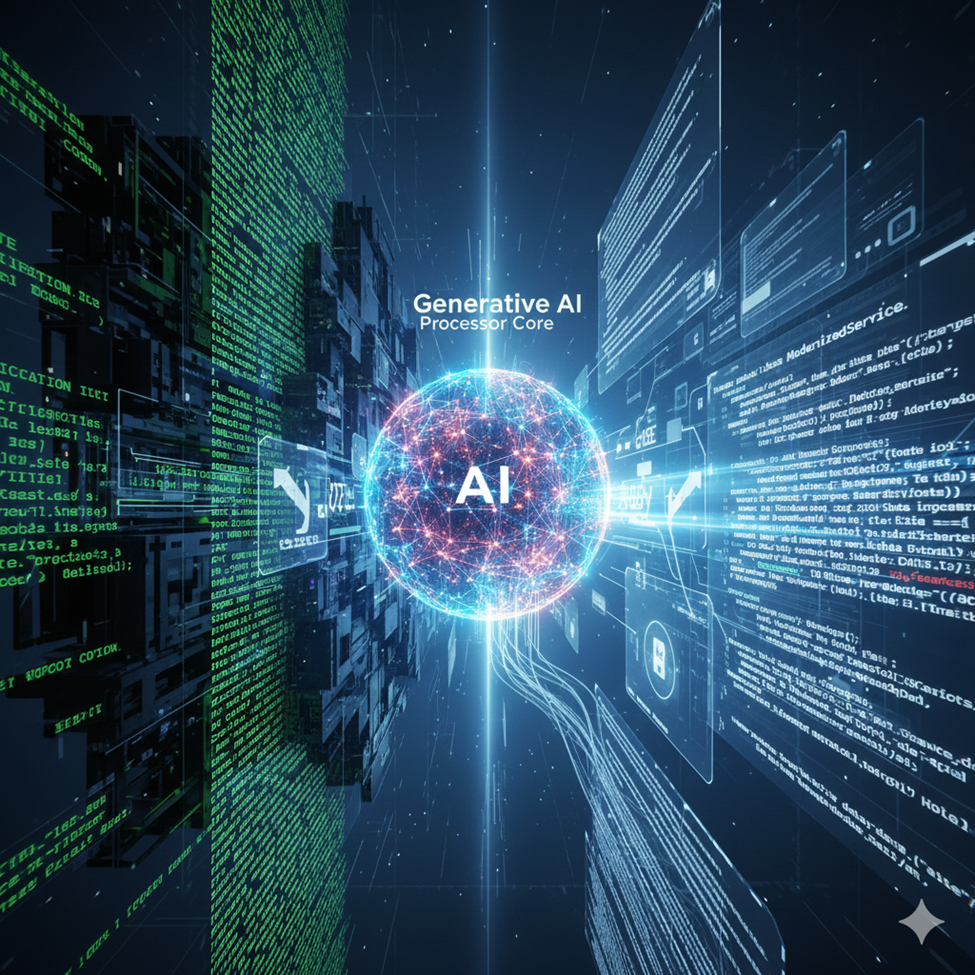
The modernization journey is complex, but GenAI delivers targeted, high-impact solutions at three critical stages.
Phase 1: Deep System Discovery and Reverse Engineering
The Challenge: The foundational knowledge of a legacy system its undocumented business logic and interconnected data flows often resides solely within the source code or with a few senior domain experts.
The GenAI Solution: Code Comprehension and Business Logic Extraction: Specialized LLMs, often fine-tuned with the client's specific codebase, are deployed to analyze the system. Rather than just reading the text, they perform a deep structural examination, typically utilizing Abstract Syntax Tree (AST) techniques. This process allows the AI to infer and formally document critical business rules and map all data dependencies. The output is not just documentation, but a clear, actionable dependency graph and a precise component map that illuminates the system's true operational logic.
Phase 2: Automated Transformation and Forward Engineering
The Challenge: Manually rewriting millions of lines of proprietary code introduces unacceptable risk of functional deviation and demands immense labor over many years.
The GenAI Solution: Code and Architecture Refactoring:
Language Conversion: GenAI models execute high-volume, automated translation of languages (e.g., COBOL to Java). This is done with an absolute mandate for functional equivalence, ensuring the new code behaves identically to the mission-critical original.
Architectural Separation: The AI can analyze the monolithic structure to logically identify and isolate internal service boundaries. It then automatically generates the foundational code for the target microservices or service-oriented architecture (SOA).
Data Migration: GenAI analyzes the legacy database structures (e.g., DB2) and autonomously generates the necessary data migration scripts and the optimized schemas required for modern, cloud-native databases (e.g., PostgreSQL).
Phase 3: Quality Assurance and Validation
The Challenge: Confirming that the new system operates exactly like the old one requires extensive, time-consuming regression testing—a major project bottleneck.
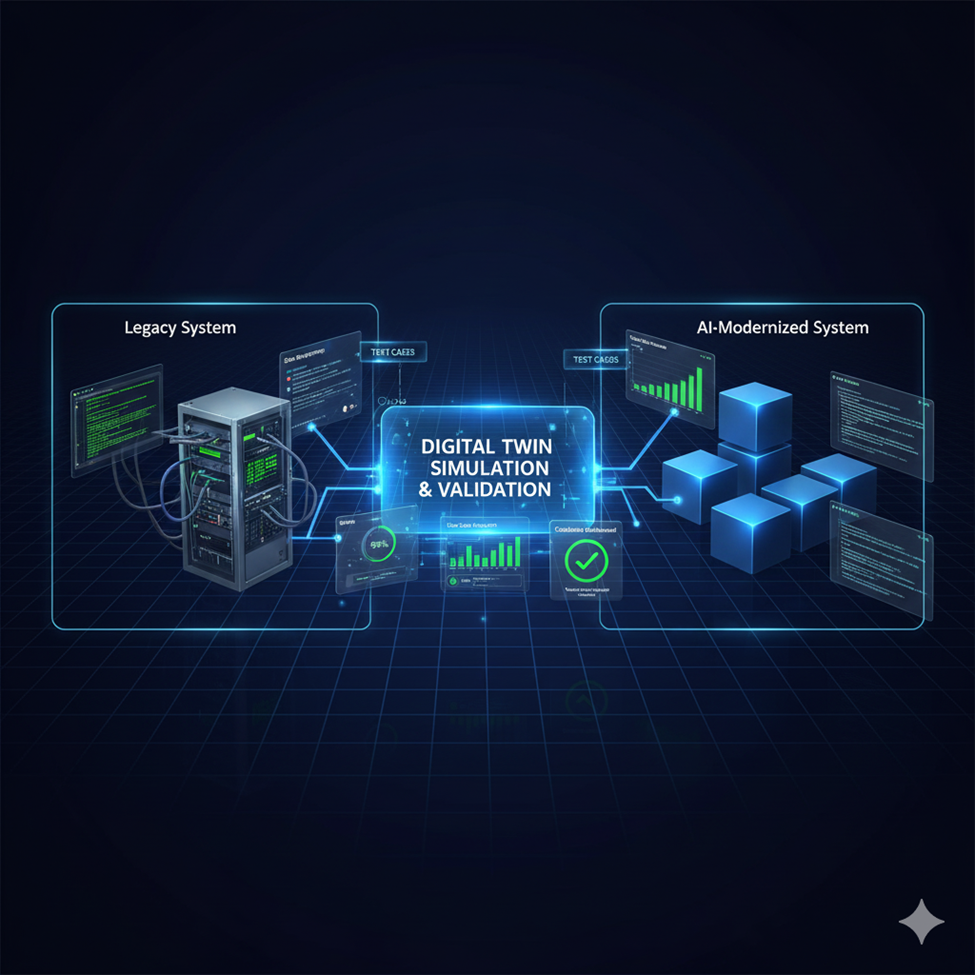
The GenAI Solution: Test Case and Harness Generation: GenAI accelerates quality assurance by analyzing the legacy system’s actual execution patterns and code structure. It then automatically generates a comprehensive suite of high-coverage unit, integration, and end-to-end test cases. Furthermore, advanced methodologies leverage GenAI to create a high-fidelity "Digital Twin" of the old system. This allows for rigorous, low-risk simulation and dual-run validation of the new system against the old before the final operational cutover.
3. Use Cases and Technical Implementation
I. Code-to-Code Transformation Precision
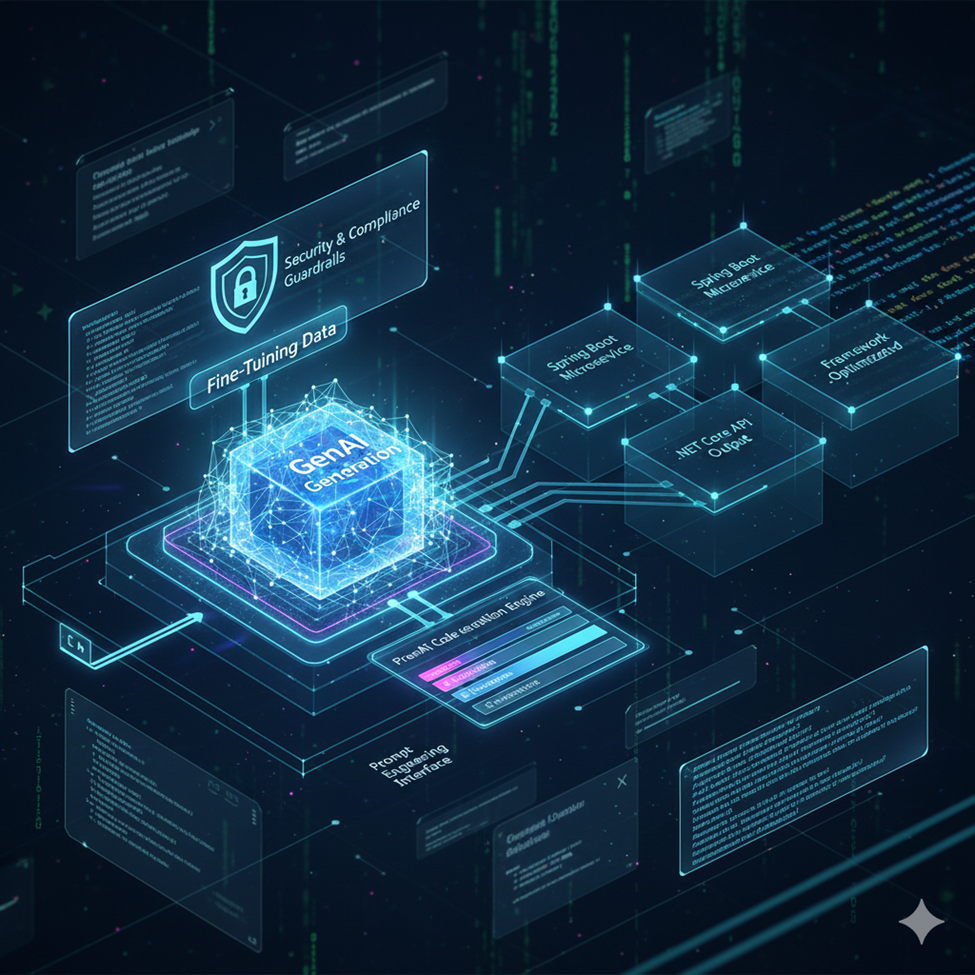
To generate robust, enterprise-grade code, foundational LLMs must be carefully optimized. This process involves fine-tuning them using the organization’s proprietary legacy code and its specific modernization standards. The successful implementation relies on highly specialized prompt engineering and internal governance guardrails. These controls ensure the generated output is not only functionally correct but also idiomatic, secure, and compliant with target frameworks like Spring Boot or .NET Core.
II. API and Integration Layer Generation
A common and highly effective modernization strategy is the strangler-fig pattern. GenAI facilitates this by analyzing the legacy system’s existing functions and data access logic to automatically generate a clean, modern RESTful or gRPC API layer (often documented with OpenAPI specifications). This API acts as an interface layer, allowing the organization to iteratively replace internal components without disrupting external services.
III. UI/UX Modernization
Generative AI can immediately enhance the end-user experience. By analyzing the screen flows and layouts of old applications, the AI can rapidly generate new wireframes and modern front-end code (e.g., in React or Vue). This dramatically cuts the time required to migrate the presentation layer, delivering early user adoption and value.
4. Challenges, Governance, and The Human Factor
I. Technical and Operational Challenges
While transformative, GenAI requires careful management:
- Model Accuracy and Assurance: GenAI code output is occasionally subject to "hallucinations." This necessitates a mandatory human-in-the-loop (HITL) validation process, supported by rigorous automated code review for all AI-generated components.
- Data Security and IP: Feeding sensitive, proprietary code into external, third-party AI models introduces significant risk. Enterprises must therefore mandate the use of secure, private, and VPC-hosted LLMs to maintain compliance and protect intellectual property.
II. Governance and Ethical AI in Modernization
Establishing a robust GenAI Governance Framework is critical. This framework must define standards for security, intellectual property protection, and code quality. It is also crucial to ensure the AI does not simply inherit and perpetuate existing, undocumented operational inefficiencies or flaws from the legacy system.
III. The Evolving Role of the Software Engineer
GenAI fundamentally alters the role of the engineer. The focus shifts away from manual reverse-engineering and laborious coding toward strategic AI-prompting, validation, and complex architectural oversight. Success in this new environment demands a new cross-functional skillset, blending deep domain knowledge with expertise in AI/ML Ops for managing code-generating systems.
5. Conclusion
The business justification for GenAI-powered modernization is clear and compelling. Organizations are achieving dramatic results: a significant reduction in project timelines (often shortened by two-thirds), rapid reduction of technical debt, and lower overall project costs. This efficiency translates directly into heightened business agility and superior operational performance.
The Future of AI-Powered Digital Transformation
Today's GenAI tools are paving the way for the future: fully autonomous "AI Agents" capable of managing and orchestrating entire modernization pipelines. This vision leads to a future IT landscape that is fundamentally self-optimizing and self-documenting, all powered by continuous Generative AI intelligence.
To capture a competitive advantage, enterprises must strategically move past pilot projects and fully commit to a GenAI-first approach to modernization. Navigating the complexity and scale of these core system transformations requires experienced, specialized partners.
Take the Next Step with Evermethod Inc
Don't let the legacy dilemma continue to hold back your digital strategy. Evermethod Inc specializes in leveraging cutting-edge Generative AI and Analytics solutions to accelerate complex digital transformation initiatives, including large-scale legacy system modernization. Our deep technical expertise ensures your critical business logic is precisely preserved while your architecture is securely migrated to a future-proof, cloud-native environment.
Contact Evermethod Inc today to begin your AI-driven modernization assessment and strategically transform your operations for maximum efficiency.
%2013.png)