
Author : Evermethod, Inc. | January 29, 2026
.png/preview.png?t=1721195409615)

AI adoption is entering a new phase. Many organizations now have capable data science teams, modern cloud platforms, and access to advanced AI models. The opportunity ahead is to translate these strengths into consistent, measurable business outcomes.
AI brings new ways of working. It influences how decisions are made, how quickly they occur, and how closely data, intelligence, and action are connected. As a result, workflows need to evolve to support these new patterns of decision-making and execution.
Reconfiguring workflows for end-to-end AI-driven transformation means designing processes where AI and people work together seamlessly. When workflows are aligned with how AI operates, insights move smoothly into action, systems operate with greater agility, and organizations are better positioned to realize lasting value from their AI investments.
Why AI Transformation Breaks at the Workflow Layer
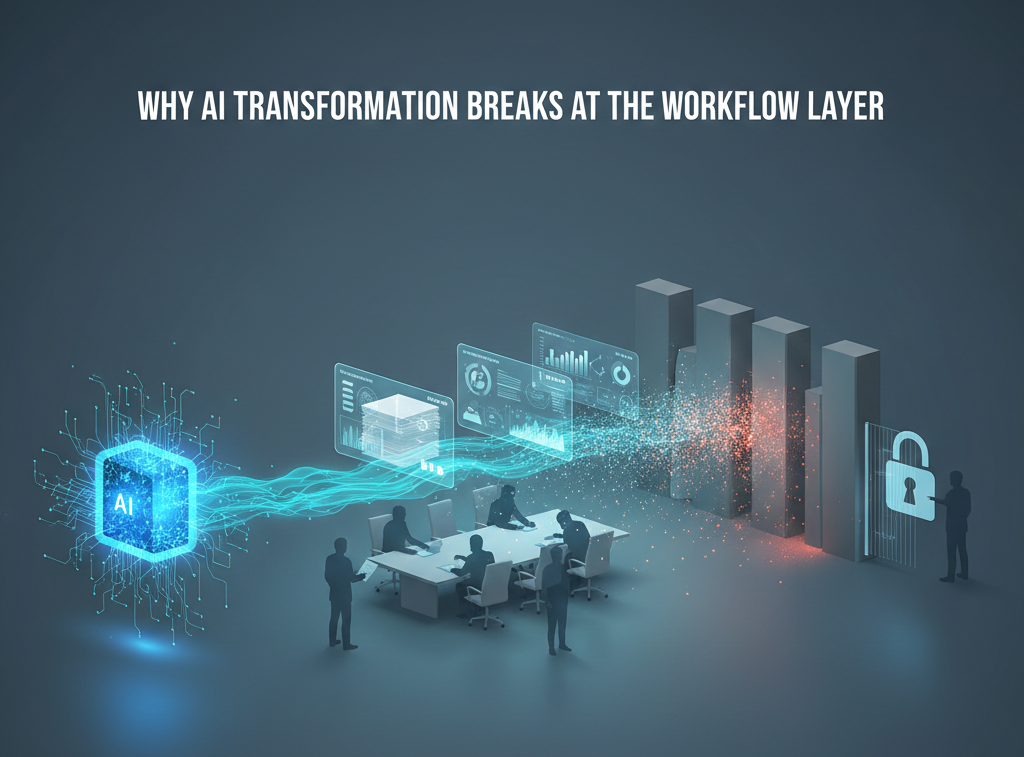
Most AI initiatives follow a familiar pattern. Teams identify a use case, build a model, validate accuracy, and surface insights through dashboards or reports. At this point, progress slows.
The model may perform well, but the organization struggles to act on its outputs. Decisions still require meetings, approvals, or manual review. By the time action is taken, the insight has often lost relevance.
This happens because traditional workflows assume that decisions are periodic rather than continuous, deterministic rather than probabilistic, and made by humans rather than systems. AI violates these assumptions. It produces signals continuously, expresses confidence instead of certainty, and expects workflows to respond in near real time.
When workflows are not redesigned to support this shift, AI becomes advisory rather than operational. It informs decisions but does not drive them.
The Structural Limits of Traditional Enterprise Workflows
.webp?width=1024&height=753&name=undefined-Jan-29-2026-07-42-41-8352-AM%20(1).webp)
Enterprise workflows were designed to optimize control, consistency, and auditability. These priorities shaped linear processes with fixed handoffs and clearly defined checkpoints.
That design works well in stable environments. It works poorly in systems driven by fast-moving data and adaptive models. Traditional workflows introduce friction in several ways. Data is processed in batches, approvals are centralized, and rules remain static even as conditions change.
AI systems rely on rapid feedback and frequent correction. They perform best when workflows can absorb uncertainty and adjust quickly.
This mismatch explains why many AI deployments stall. The workflow cannot keep pace with the intelligence flowing through it.
What End-to-End AI-Driven Workflows Actually Look Like
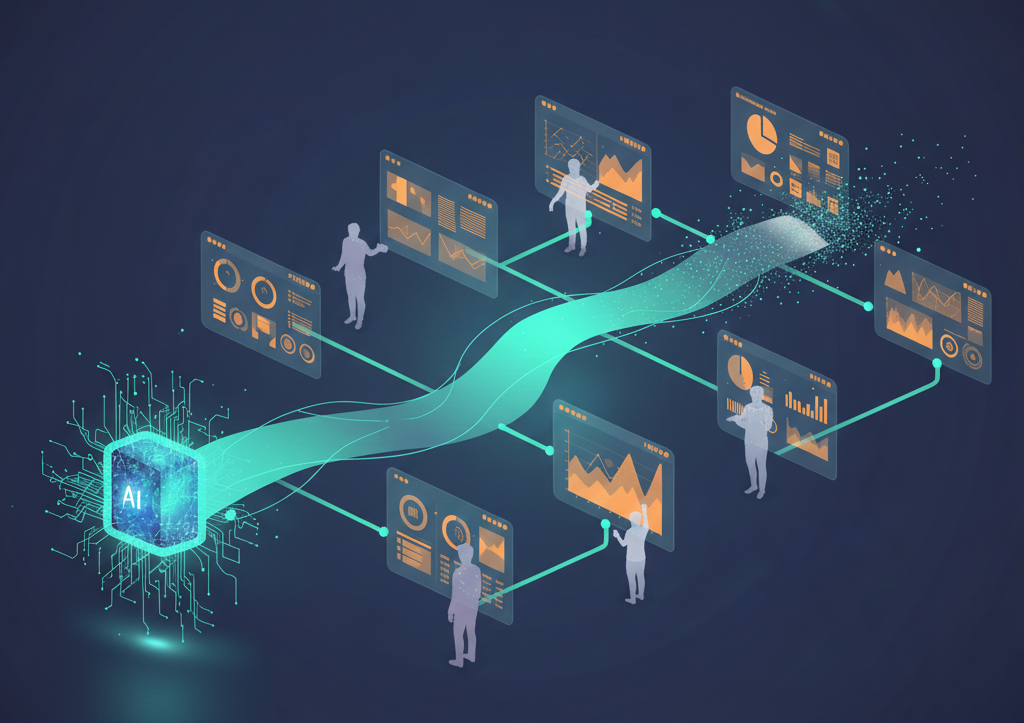
An end-to-end AI-driven workflow connects data, intelligence, and action into a continuous loop. Insight does not stop at analysis. It moves directly into execution.
In these workflows, data is ingested as events occur. Features are generated in near real time. Models produce predictions with confidence scores. Decisions are made automatically within defined guardrails. Outcomes feed back into future predictions.
Human involvement does not disappear. Instead, it shifts to oversight and exception handling.
|
Mode of Control |
How Humans Participate |
|
Human-in-the-loop |
Review high-risk or low-confidence decisions |
|
Human-on-the-loop |
Monitor system behavior and performance |
|
Fully automated |
Allow AI to act within approved boundaries |
The key change is that humans move from constant decision-making to strategic supervision.
The Architectural Changes That Enable AI-Driven Execution
%20(1).webp?width=1024&height=796&name=undefined-Jan-29-2026-07-46-40-7600-AM%20(2)%20(1).webp)
To support AI-driven workflows, architecture must evolve. Systems designed for request-response interaction and batch analytics are no longer sufficient.
Event-driven design forms the foundation. Workflows react immediately to changes in system state instead of waiting for scheduled jobs or manual triggers.
Streaming data pipelines replace batch processing. Feature stores ensure consistent and governed inputs for models. Inference services expose predictions through low-latency APIs. Decision engines combine model outputs with business logic to determine the next action.
|
Architectural Layer |
Role in the Workflow |
|
Event ingestion |
Capture real-time signals |
|
Feature store |
Standardize model inputs |
|
Inference service |
Generate predictions |
|
Decision engine |
Apply thresholds and rules |
|
Orchestration |
Execute workflow actions |
These components must operate as a single execution fabric. When treated as separate tools, latency and complexity return.
Operationalizing AI Within Live Workflows
.webp?width=1024&height=717&name=undefined-Jan-29-2026-07-46-37-8602-AM%20(1).webp)
Once AI is embedded into workflows, operational concerns become unavoidable. Models evolve. Data shifts. Behavior changes in response to automated decisions.
This makes lifecycle management essential. Workflows must support versioned deployments, controlled rollouts, and fast rollback when performance degrades.
Drift is one of the most common failure modes in production AI.
|
Drift Type |
Impact |
|
Data drift |
Model inputs change |
|
Concept drift |
Relationships between inputs and outcomes shift |
|
Feedback drift |
AI actions influence future data |
Effective workflows detect drift early and respond automatically. They either adjust behavior or escalate decisions to human review before failures spread.
Observability must extend beyond infrastructure. Teams need visibility into decisions themselves, including why a prediction was made and what outcome followed.
Governance, Risk, and Trust Built into the Workflow
.webp?width=1024&height=881&name=undefined-Jan-29-2026-07-46-39-6943-AM%20(1).webp)
As AI takes on a more active role in decision-making, governance cannot remain external or manual. It must be embedded into execution.
This includes confidence thresholds that control automation, mandatory review for sensitive actions, and traceability from data to decision to outcome.
When governance is part of the workflow, it becomes a source of trust rather than friction.
|
External Governance |
Embedded Governance |
|
Post-hoc audits |
Real-time enforcement |
|
Manual reviews |
Automated controls |
|
Slows adoption |
Enables safe scaling |
This approach allows organizations to expand AI usage without losing accountability.
A Practical Path to Reconfiguring Workflows
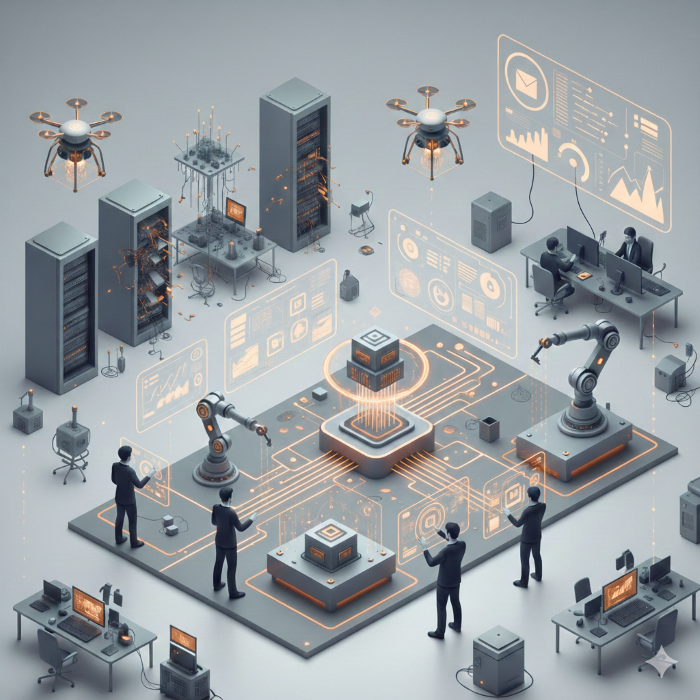
Reconfiguring workflows for AI does not require a full redesign at once. It requires focus and sequencing.
The most effective starting points are workflows that involve frequent decisions, rely on time-sensitive data, and have clear business impact.
A practical approach includes mapping decision points, identifying where AI can reduce latency or improve accuracy, redesigning execution paths to close the loop from insight to action, and adding observability and governance early.
Common mistakes include automating unstable processes, isolating AI from execution, and ignoring failure scenarios. Successful organizations treat AI as an operating capability rather than a side experiment.
Conclusion
AI does not transform organizations on its own. Transformation happens when workflows are redesigned to execute intelligence continuously and responsibly.
Organizations that succeed with AI build workflows that sense, decide, act, and learn as part of everyday operations. They respond earlier, adapt faster, and manage risk more effectively. The differentiator is not smarter models. It is smarter execution.
What Workflow Redesign Means for Enterprise Value
When a company reconfigures its workflows around AI, ownership of that workflow can shift — sometimes to the company, sometimes away from it. That shift changes retention, pricing power, and competitive position. Evermethod AI helps investors and operators see which direction it's moving before it shows up in the numbers.
%2013.png)
-1%20(1).png)