
Author : Evermethod, Inc. | January 9, 2026
.png/preview.png?t=1721195409615)

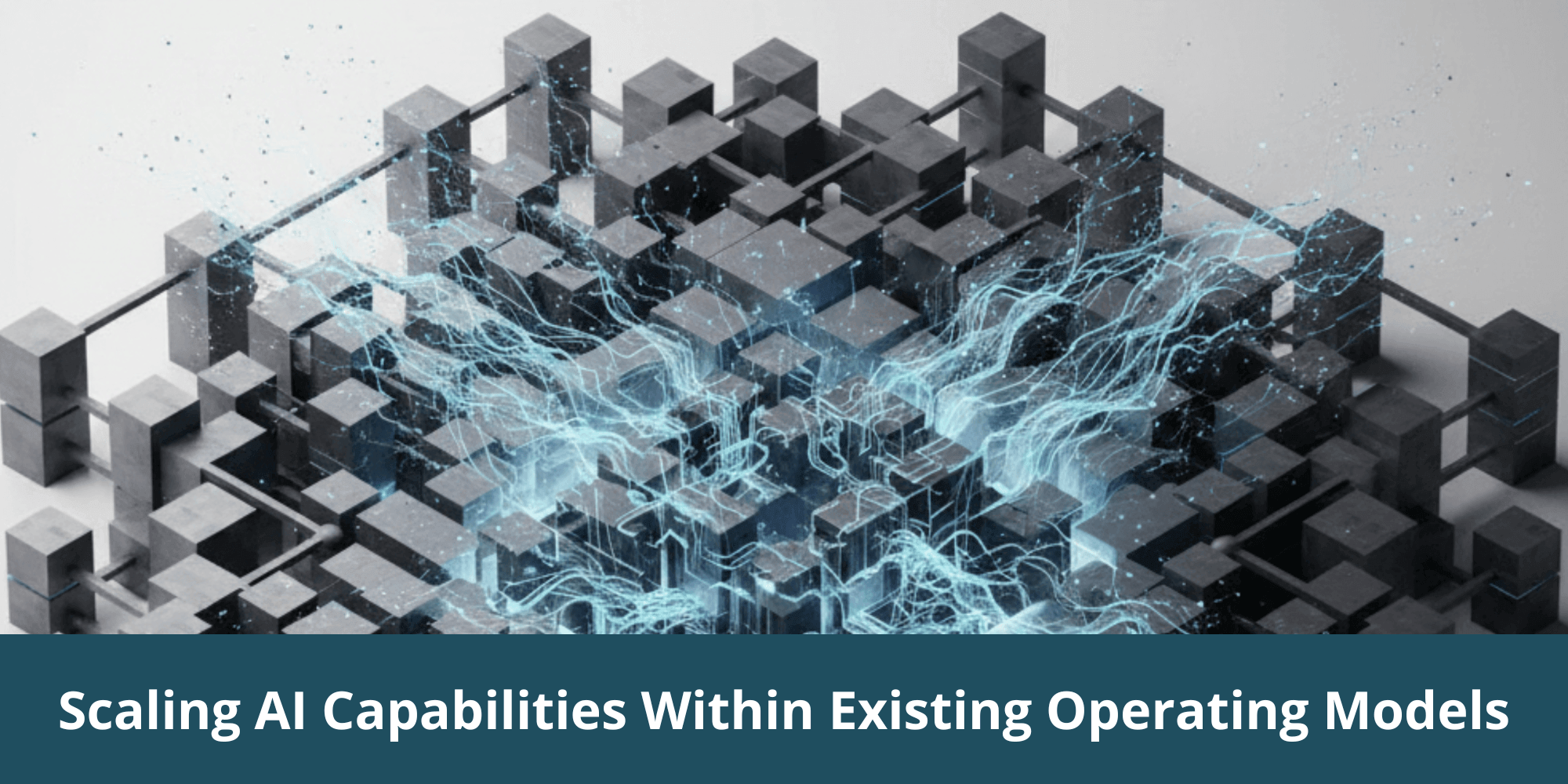
Most enterprises can demonstrate AI value in isolated initiatives. What they struggle with is making AI dependable, repeatable, and scalable across the organization. Early successes stall when AI must coexist with real systems, operational processes, and formal accountability.
The challenge is structural rather than technical. Enterprise operating models were designed for deterministic systems and predictable change. AI systems behave differently. They learn continuously, depend on evolving data, and produce probabilistic outcomes. Scaling AI means reconciling these differences without sacrificing stability or control.
From Experimental AI to Operational Responsibility

Early AI initiatives are typically framed as experiments. Teams focus on learning and speed. Models are trained on historical data snapshots, and outputs are reviewed by humans rather than executed automatically.
As AI scales, this model breaks down. AI begins to influence operational decisions and automated workflows. At this point, responsibility must be formalized.
Enterprises must explicitly define:
- Ownership of AI-influenced decisions
- Accountability for outcomes when models underperform
- Authority to pause, override, or roll back AI behavior
Without this clarity, AI remains trapped at the pilot stage because no team is structurally prepared to own its impact.
Why Existing Operating Models Become the Constraint

Enterprise operating models exist to control risk. They define approval paths, release cycles, segregation of duties, and escalation mechanisms. These controls assume that system behavior changes only when code changes.
AI challenges this assumption:
- Model behavior shifts as data distributions change
- Retraining introduces new logic outside application release cycles
- Decision outcomes are statistical rather than deterministic
Scaling AI requires deliberately mapping AI activities to existing controls. Model updates must be treated as governed changes. Retraining schedules must be defined. Risk ownership must be explicit.
Organizations that align AI with operating models move slower initially but scale faster in the long run.
Traditional systems change in steps. AI systems change continuously. Data evolves, models drift, and performance shifts even when no code is deployed. Treating AI change as an exception rather than the norm creates operational friction and hidden risk.
Organizations that scale AI successfully normalize this reality. Retraining is planned, not reactive. Performance thresholds are defined in advance. Model behavior is reviewed as part of regular operations, not only during incidents. This does not eliminate risk, but it makes risk visible and manageable.
In this context, stability does not mean immobility. It means controlled evolution.
Data Foundations as an Operational System
-png.png?width=500&height=500&name=Gemini_Generated_Image_bz6h5obz6h5obz6h%20(1)-png.png)
At scale, data is not an input to AI. It is a critical dependency.
Operational AI depends on stable and governed data pipelines. Without control, upstream data changes silently alter model behavior.
Enterprises that scale AI operationalize data through:
- Clearly owned datasets with documented purpose
- Versioned schemas and enforced contracts
- Lineage connecting predictions to source data
- Change management processes for critical data assets
This discipline allows organizations to explain outcomes and maintain trust in AI systems.
Managing Models as Part of the System Landscape

As AI adoption grows, model count increases rapidly. Without structure, organizations lose visibility and control.
Common failure modes include:
- Duplicate models solving similar problems
- Inconsistent retraining practices
- Loss of institutional knowledge when teams change
Scalable AI programs treat models as enterprise assets. Each model has:
- A defined owner and business purpose
- Documented data dependencies
- Controlled promotion to production
- Clear retraining and retirement criteria
This approach reduces risk and enables reuse across the organization. As AI becomes operational, traditional model metrics lose their primacy. Accuracy alone does not reflect whether AI is helping the organization function better. What matters is whether decisions improve, whether operations remain stable, and whether outcomes align with business intent.
Mature organizations evolve their measurement accordingly. They examine downstream effects, adoption patterns, and operational impact. These signals provide a more honest assessment of AI’s value and prevent optimization around narrow technical goals.
Aligning AI Delivery with Enterprise Engineering Practices
-png.png?width=500&height=500&name=Gemini_Generated_Image_fbfpnufbfpnufbfp%20(1)-png.png)
AI cannot scale as a parallel delivery process. When models bypass established engineering practices, fragility increases.
Successful organizations integrate AI into existing CI and CD pipelines by:
- Automating data validation and model testing
- Enforcing consistent environments through infrastructure as code
- Coordinating model releases with application releases
This alignment increases predictability and reduces production incidents. Scaling AI within existing operating models is not about moving faster or experimenting more aggressively. It is about integration with intent. Enterprises that succeed align AI with how decisions are made, risks are owned, and systems are operated. They accept uncertainty, but they do not abandon discipline.
When done well, AI stops being a series of initiatives and becomes part of how the organization works dependable, governed, and designed to evolve.
Designing AI for Operational Use, Not Just Accuracy
-png.png?width=500&height=500&name=Gemini_Generated_Image_utpau9utpau9utpa%20(1)-png.png)
High accuracy does not guarantee operational success. High accuracy does not guarantee operational success. Models that perform well in controlled environments often fail to deliver value once exposed to real-world constraints such as traffic spikes, degraded data quality, or downstream system dependencies.
Operational AI systems must meet requirements beyond predictive performance. They must respond within acceptable latency bounds, sustain required throughput under peak load, and remain available when dependent services fail. At scale, cost efficiency also becomes a design constraint. A model that is accurate but expensive to run, difficult to scale, or fragile under load will eventually be constrained or decommissioned.
Operational AI systems must meet requirements for:
- Latency and throughput
- Availability and resilience
- Cost efficiency at scale
Enterprises must also design for failure. When predictions are unreliable or data is unavailable, systems must fall back to deterministic logic or human review. This ensures continuity and builds trust.
Conclusion
Scaling AI within existing operating models is not about moving faster or experimenting more aggressively. It is about integration with intent. Enterprises that succeed align AI with how decisions are made, risks are owned, and systems are operated. They accept uncertainty, but they do not abandon discipline.
When done well, AI stops being a series of initiatives and becomes part of how the organization works dependable, governed, and designed to evolve.
What Scaling AI Means for Enterprise Value
Which capabilities a company chooses to scale and which it doesn't, is itself a signal of where AI is creating or eroding value. Evermethod AI helps investors and operators separate the initiatives that strengthen competitive position from the ones that just add operating cost.
%2013.png)