
Author : Evermethod, Inc. | April 18, 2026
.png/preview.png?t=1721195409615)

Why QA Needs a Rethink
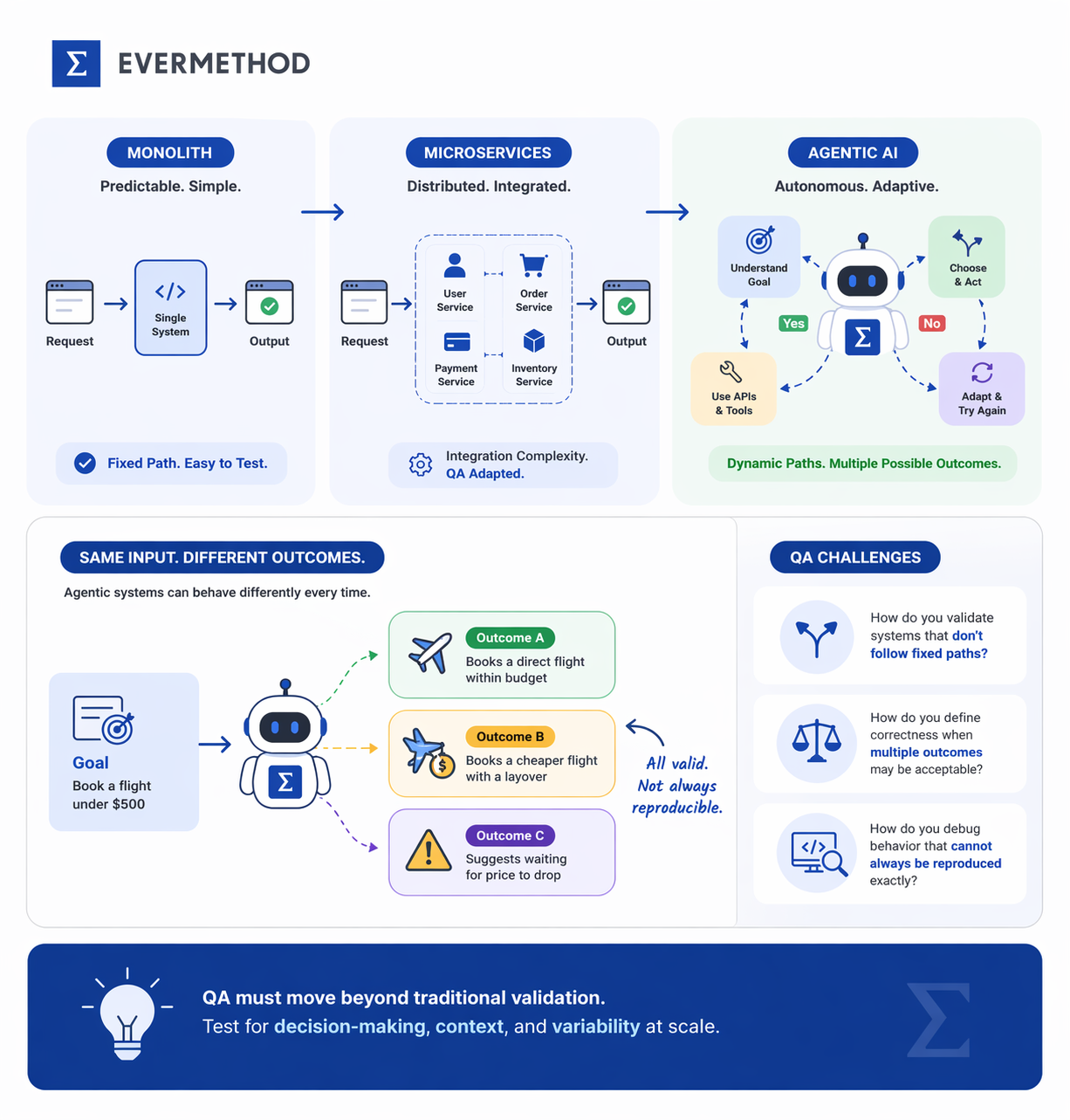
Quality assurance has always evolved alongside software architecture. When systems were monolithic, testing focused on end-to-end validation. With micro services, QA adapted to distributed components and integration complexity. Now, with the rise of agentic AI, the shift is deeper and more fundamental.
Agentic systems introduce a new execution model. Instead of following predefined logic, they interpret goals, decide on actions, and adapt dynamically as conditions change. This means the same system can behave differently across runs, even when the objective remains unchanged.
For QA teams, this creates a practical challenge rather than a theoretical one:
- How do you validate systems that don’t follow fixed paths?
- How do you define correctness when multiple outcomes may be acceptable?
- How do you debug behavior that cannot always be reproduced exactly?
These are not edge cases they are core characteristics of agentic AI.
As a result, testing must move beyond traditional validation techniques and adopt models that account for decision-making, context, and variability at scale.
The Hidden Complexity of Agentic Systems
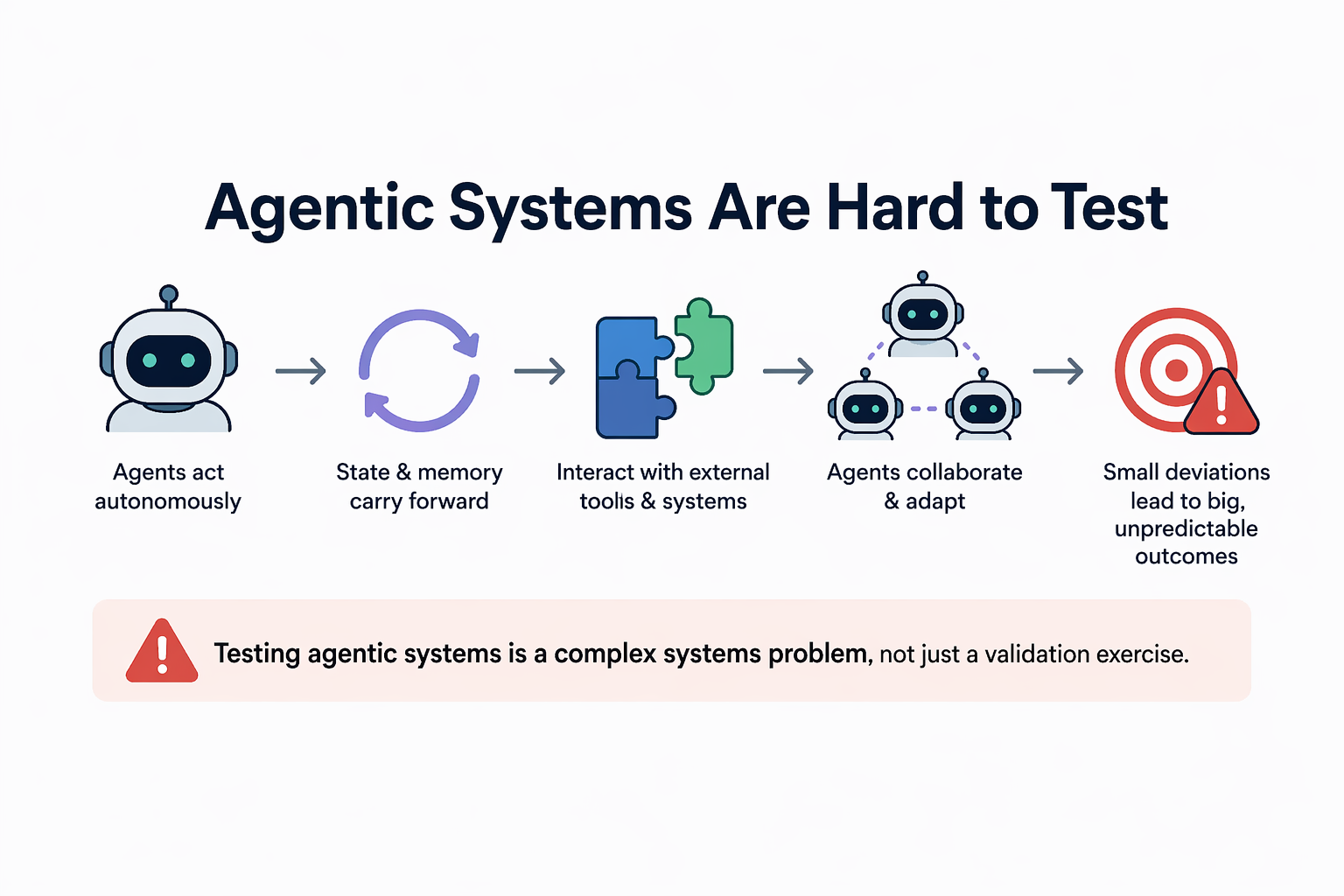
What makes agentic AI difficult to test is not just its intelligence, but its structure.
Unlike traditional systems, agents operate with a high degree of autonomy. They determine how to achieve an objective rather than following a predefined path. This introduces variability at every step of execution.
That variability compounds over time.
Because these systems are stateful, they carry context across interactions. A small deviation early in a workflow can influence outcomes much later, making failures harder to trace and reproduce.
The challenge deepens when agents interact with external systems. APIs, databases, and third-party services introduce uncertainty that lies outside direct control. Even if the agent behaves correctly, its environment may not.
In more advanced architectures, multiple agents collaborate. They exchange information, divide responsibilities, and adapt to each other’s actions. This creates emergent behavior outcomes that cannot be fully predicted in advance.
To put this into perspective:
|
Characteristic |
Impact on Testing |
|
Autonomy |
No fixed execution paths |
|
Statefulness |
Errors propagate over time |
|
Tool interaction |
External failures affect outcomes |
|
Memory |
Context errors lead to incorrect decisions |
|
Multi-agent systems |
Emergent, unpredictable behavior |
Taken together, these factors transform testing from a controlled validation exercise into a complex systems problem.
Where Traditional QA Breaks Down
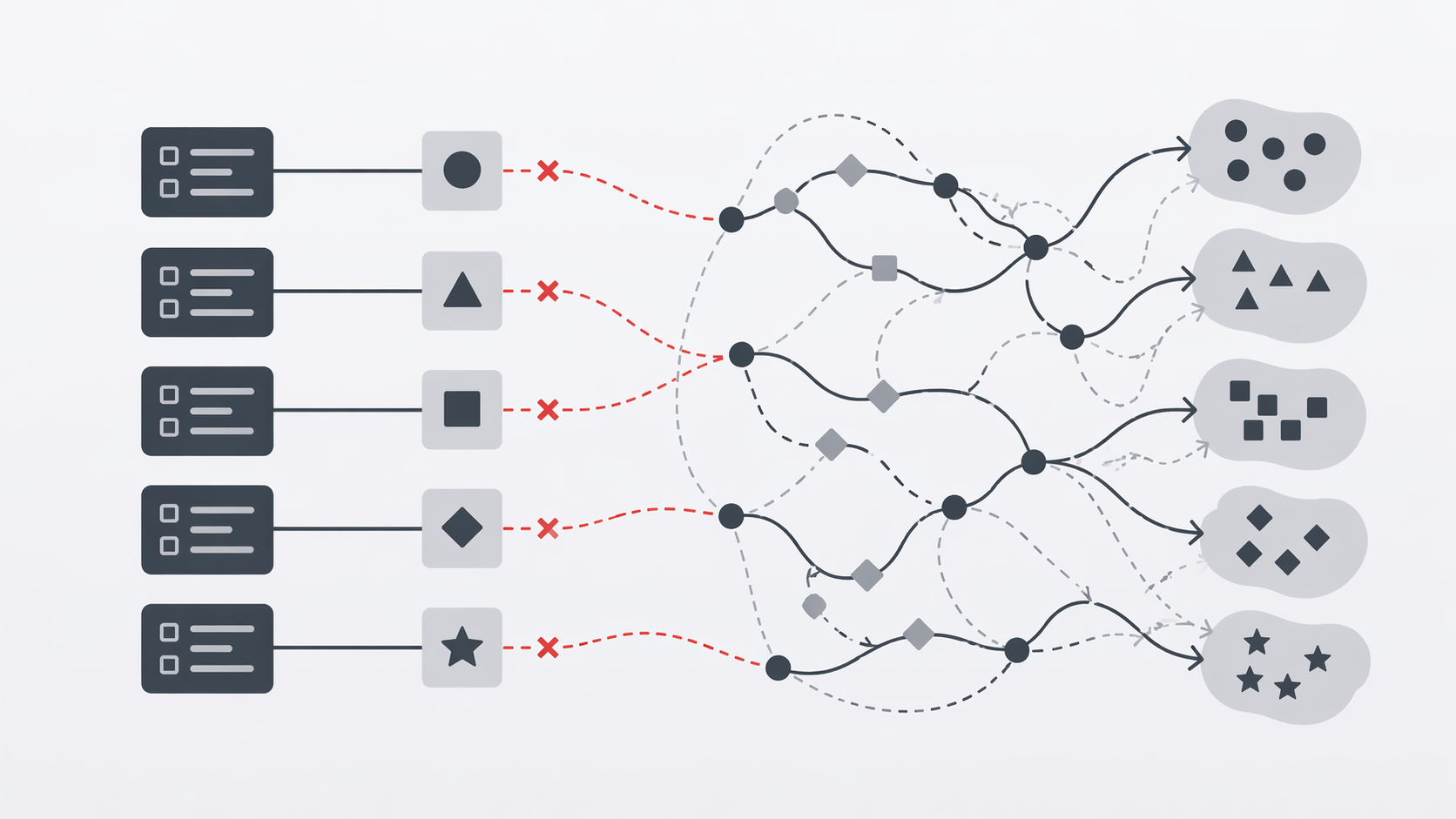
Conventional QA frameworks struggle because they are built for certainty. Unit testing assumes that components can be isolated and validated independently. In agentic systems, decisions depend heavily on context, making isolation less meaningful.
Even more challenging is the question of correctness. In deterministic systems, there is a single expected outcome. In agentic systems, multiple outcomes may be acceptable. The evaluation depends on whether the system achieved its goal efficiently and within constraints not whether it produced a specific result.
Non-determinism further complicates matters. Running the same scenario multiple times may produce different outcomes, all of which could be valid. This makes debugging less about identifying a single failure and more about understanding patterns of behavior.
At the same time, the environment itself is constantly changing. External dependencies evolve, data shifts in real time, and new edge cases emerge. Static test cases cannot capture this level of dynamism.
A Shift in Perspective: From Outputs to Behavior
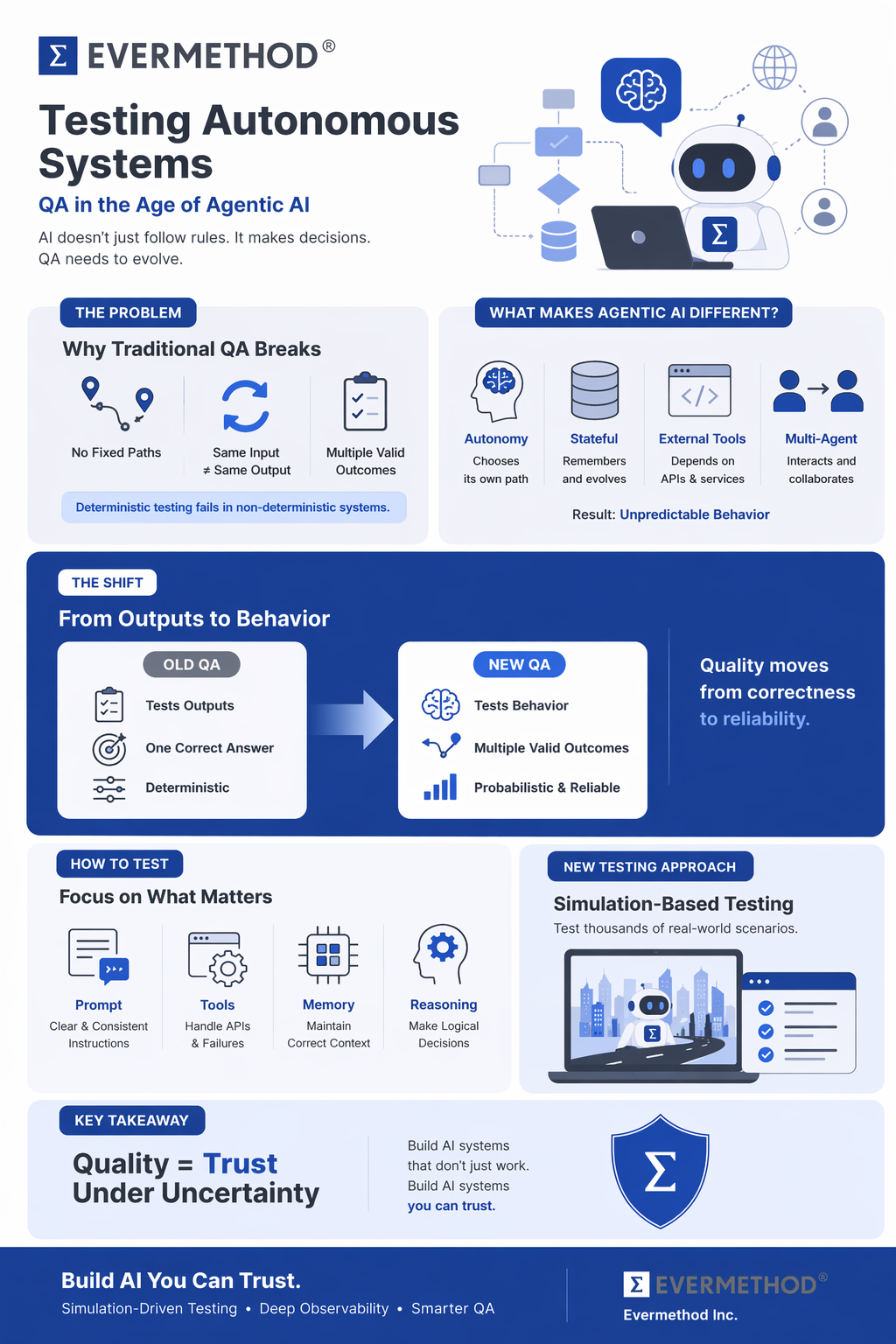
To test agentic systems effectively, QA must adopt a behavioral lens. This means looking beyond the final result and examining the path taken to reach it. The sequence of decisions, the use of tools, and the handling of unexpected conditions all become critical indicators of quality.
In practice, this changes how success is defined:
- Success is no longer binary
- Multiple execution paths may be valid
- Efficiency and constraint adherence matter as much as outcomes
This shift also introduces the need for policy-driven validation. By establishing clear rules and constraints, organizations can ensure that autonomous systems operate safely, even when their behavior varies.
Evaluation becomes probabilistic rather than absolute, relying on patterns observed across multiple runs rather than a single execution.
Building a Layered Testing Strategy
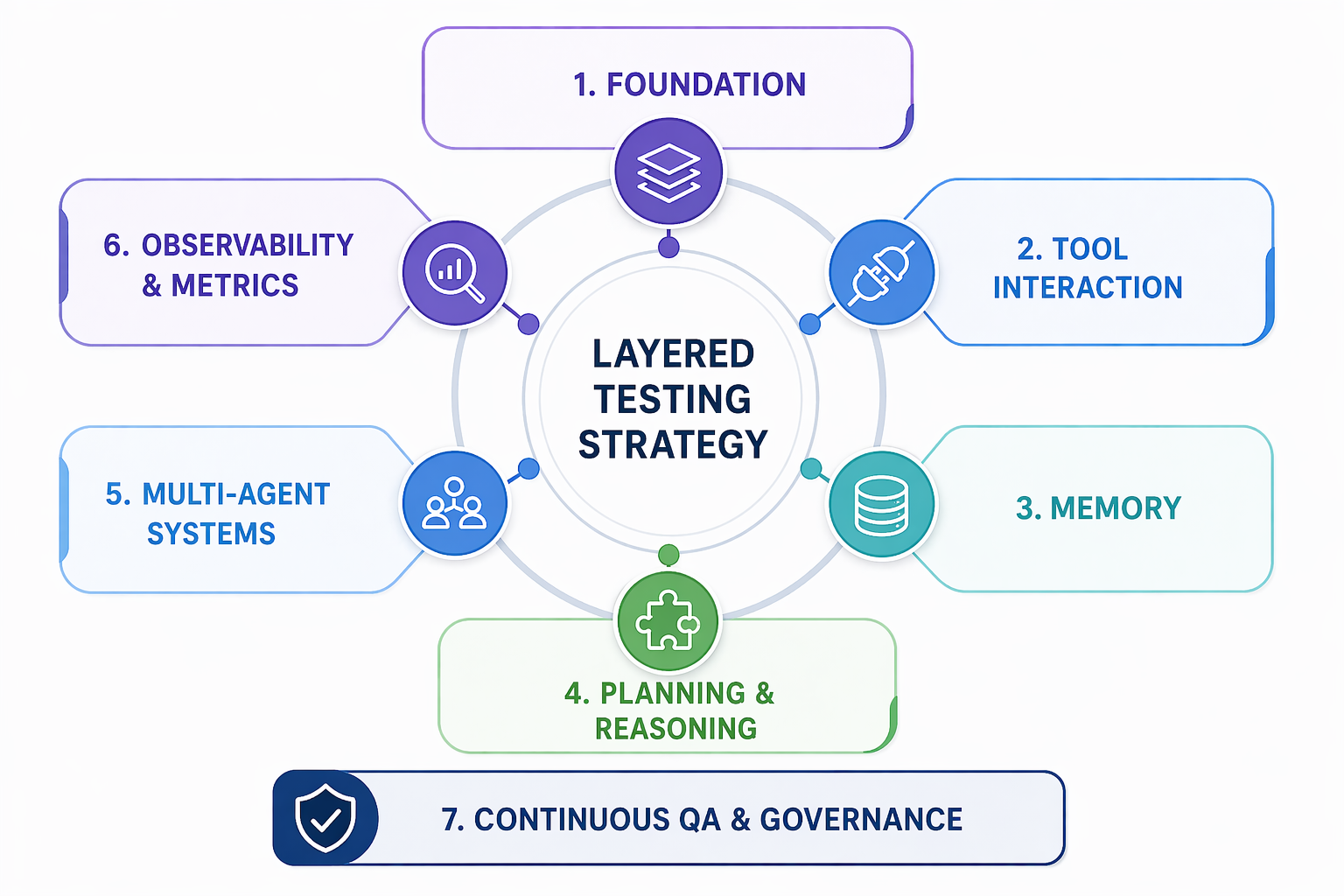
Testing agentic AI requires a structured approach that addresses different layers of system behavior. At the foundational level, prompt and policy design must be validated for consistency and robustness. Since prompts directly influence how agents interpret tasks, even minor ambiguities can lead to significant deviations in execution.
Tool interaction testing focuses on how agents integrate with external systems. This includes validating API contracts, handling failures gracefully, and ensuring resilience under partial system outages.
Memory testing ensures that context is retained accurately over time. Since agents rely on memory to inform decisions, inconsistencies in context management can result in flawed reasoning.
Planning and reasoning evaluation examines how agents construct and execute strategies. This involves assessing logical consistency, efficiency, and the ability to adapt when initial plans fail.
In multi-agent systems, testing must also account for coordination dynamics, ensuring that agents collaborate effectively without conflict or instability.
Simulation: Testing Beyond Static Scenarios
Static testing environments are not sufficient for agentic systems. Simulation provides a more realistic and flexible approach by enabling teams to evaluate system behavior under controlled yet dynamic conditions. Through simulation, agents can be exposed to edge cases, rare events, and adversarial inputs that are difficult to replicate manually.
Digital twins extend this capability by replicating production environments with high fidelity. This allows organizations to test how agents will behave in real-world scenarios without introducing operational risk.
Simulation also enables scale. Instead of relying on a limited set of predefined test cases, teams can generate thousands of scenarios, uncovering patterns and vulnerabilities that would otherwise remain hidden.
Observability: Understanding Decisions in Real Time
As systems become more autonomous, visibility becomes essential.
Traditional logging captures events. Agentic QA requires understanding decisions. This calls for deeper observability tracking state transitions, decision points, and interactions with external systems. Execution tracing allows teams to reconstruct the full sequence of actions taken by an agent, making it easier to diagnose issues even in non-deterministic environments.
Key evaluation metrics include:
- Task success rate
- Decision latency
- Resource utilization
- Error propagation patterns
These metrics provide a more comprehensive view of system behavior and help identify areas for improvement.
Continuous QA: An Always-On Discipline
In agentic AI, testing does not end at deployment. It becomes a continuous process that spans the entire system lifecycle. Early-stage validation ensures that foundational issues are addressed during development, while production monitoring captures real-world behavior and emerging edge cases.
Human oversight remains critical, particularly in complex or high-risk scenarios. While automation enables scale, expert judgment is necessary to evaluate nuanced decisions and ensure alignment with business objectives.
Regression testing must also evolve. Instead of verifying static outputs, it should focus on detecting behavioral drift as systems are updated or retrained.
Production guardrails, such as policy enforcement and fallback mechanisms, provide an additional layer of safety, ensuring that systems remain controllable even under unexpected conditions.
Governance: Ensuring Accountability at Scale
As autonomy increases, so does the need for accountability. Organizations must ensure that decisions made by agentic systems are traceable and auditable. This is particularly important in regulated environments, where compliance requirements demand transparency.
Risk management frameworks should be integrated into QA processes, enabling teams to identify and mitigate potential failure scenarios proactively. Ethical considerations must also be embedded into system design and validation, ensuring that agents operate within acceptable boundaries. Governance is no longer separate from QA it is an extension of it.
Conclusion
Agentic AI represents a shift not just in technology, but in how quality itself is defined. The focus moves away from static correctness toward consistent, reliable behavior under uncertainty. Testing these systems requires approaches that account for variability, context, and long-term decision-making.
Organizations that adapt their QA strategies accordingly will be better positioned to deploy autonomous systems with confidence. Because ultimately, the goal is not just to build intelligent systems it is to build systems that can be trusted.
Build Trust into Your Agentic AI Systems

As enterprises adopt agentic architectures, ensuring reliability becomes a critical challenge.
At Evermethod Inc, we help organizations design and implement advanced QA frameworks tailored for autonomous systems. From simulation-driven testing to deep observability and governance, we ensure your AI operates reliably in real-world conditions.
If your systems are making decisions independently, your QA strategy needs to evolve just as fast.
Partner with Evermethod Inc to build AI systems that are not only intelligent but dependable.
%2013.png)