.png?width=882&height=158&name=882x158%20(1).png "882x158 (1)")

Author : Evermethod, Inc. | February 25, 2026
.png/preview.png?t=1721195409615)

Enterprise SaaS platforms are some of the most reliable systems inside modern organizations. CRM manages revenue pipelines. ERP coordinates operations. HR systems structure workforce data. Finance platforms ensure control and compliance.
These systems are not broken. They are mature, stable, and deeply integrated into daily operations. What has changed is the expectation placed on them.
Leadership teams increasingly want systems that do more than execute predefined workflows. They want systems that interpret signals across departments, coordinate decisions, and adapt in real time. That expectation exposes a structural gap. Most SaaS platforms are optimized for execution within domains, not reasoning across them.
An agentic layer addresses that gap without requiring a wholesale replacement of the existing stack.
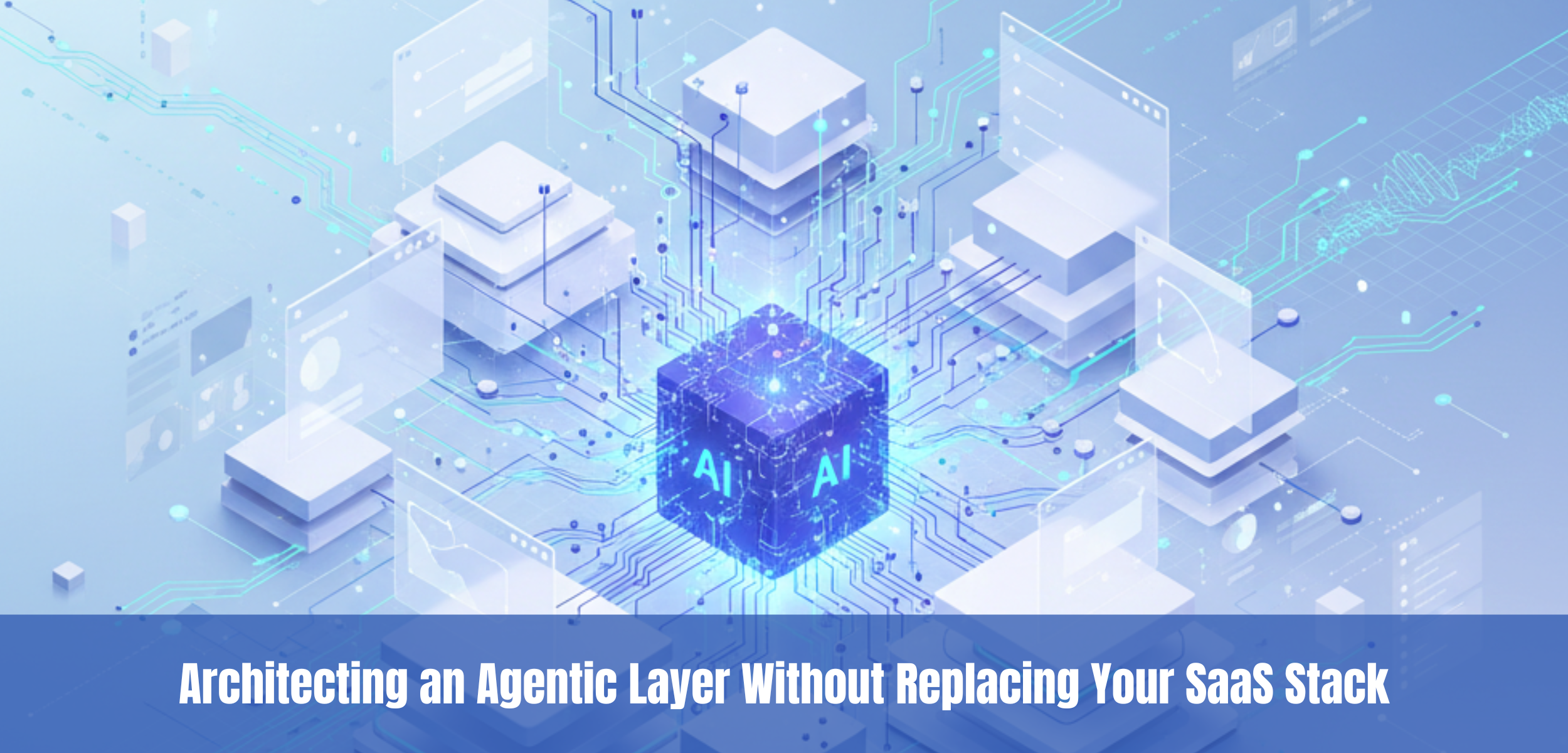
It operates as an intelligence overlay. It observes activity across systems, reasons over combined context, and triggers actions through controlled interfaces. The SaaS platforms remain systems of record. The agentic layer becomes the coordination layer.
The Coordination Gap in Modern Enterprise Stacks

Traditional SaaS architecture is workflow-centric. It answers a clear question: if this event occurs, what step comes next?
That model works well for predictable processes. It becomes limited when decisions depend on signals from multiple systems.
Consider a typical cross-functional scenario:
- Sales data indicates strong pipeline growth.
- Finance signals tightening cash flow.
- Operations show capacity constraints.
- HR reports hiring delays.
Each system is accurate within its domain. None of them synthesizes the full picture.
In practice, humans perform that synthesis. They gather reports, reconcile differences, and decide how to respond. This is where latency and inconsistency enter the process.
An agentic layer is designed to operate at that intersection. It introduces structured decision loops that:
- Monitor events across systems
- Combine structured and unstructured context
- Apply reasoning within defined guardrails
- Trigger coordinated actions
- Capture feedback for continuous refinement
This is not about replacing workflows. It is about coordinating outcomes.
What an Enterprise Agentic Layer Actually Requires
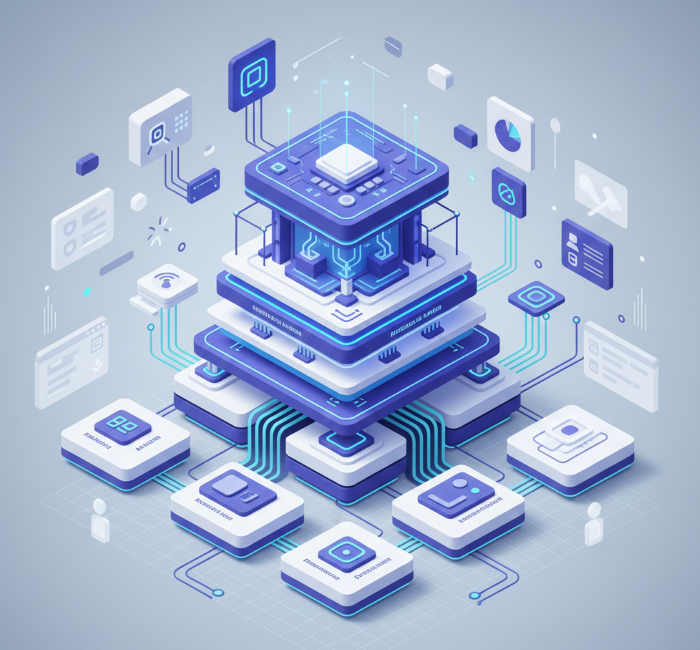
Production-grade agentic systems are architectural constructs, not experimental integrations.
A reliable implementation typically includes the following elements.
Orchestration Infrastructure
An orchestration engine manages how tasks are decomposed and executed. It determines:
- Which agents are responsible for specific tasks
- How dependencies are resolved
- How failures are handled
- How actions are sequenced
Without orchestration, agents operate independently and inconsistently.
A Structured Reasoning Model
Enterprise reasoning cannot rely solely on generative output. Effective systems combine:
- Language models for contextual interpretation
- Deterministic rules for policy enforcement
- Retrieval systems grounded in trusted enterprise data
This hybrid model balances flexibility with control.
Secure Integration Layer
Agents interact with SaaS platforms through formal interfaces. That layer must enforce:
- Strict schema validation
- Rate-limit awareness
- Idempotent write operations
- Transaction logging
This protects the integrity of core systems.
Context and Memory Management
Agents must operate with stable context. That typically includes:
- Short-term task memory
- Long-term institutional knowledge
- Unified representations of entities across systems
Without disciplined context management, performance degrades quickly.
Governance and Control Plane
Autonomous capabilities require structured oversight. A control plane defines:
- Role-based permissions
- Risk tiers for agent actions
- Approval thresholds
- Version control and audit trails
Governance is not separate from architecture. It is embedded within it.
Integration Without Disruption

The architectural objective is clear: introduce intelligence without destabilizing existing systems.
An overlay model achieves this by maintaining separation between execution systems and coordination logic.
In this model:
- SaaS cores remain unchanged.
- The agentic layer subscribes to events or queries APIs.
- All write operations are validated before execution.
- Failures in the agentic layer do not halt core operations.
This approach reduces operational risk and simplifies maintenance.
The Practical Work of Data Alignment
Before reasoning can occur, context must be unified.
Enterprise systems rarely share identical identifiers, schemas, or hierarchies. Aligning them involves:
- Resolving entities across platforms
- Standardizing field definitions
- Identifying systems of record
- Managing latency and update timing
This work is foundational. It determines whether decisions are consistent or contradictory.
Organizations that invest in this alignment build agentic systems that scale. Those that skip it encounter fragmentation.
Operating and Scaling the Agentic Layer

Introducing an agentic layer changes how decisions are made. That shift must be supported by operational discipline.
Clear Autonomy Boundaries
Agents should be categorized clearly:
- Advisory agents that recommend actions
- Semi-autonomous agents operating within thresholds
- Fully autonomous agents restricted to low-risk domains
This tiering enables controlled adoption.
Observability and Performance Monitoring
Enterprise systems require visibility. Effective monitoring tracks:
- Decision accuracy
- Action success rates
- Latency
- Business impact metrics
Observability builds trust and enables iterative improvement.
Platform Thinking for Scale
As use cases expand, consistency becomes critical. Successful organizations standardize:
- Integration connectors
- Logging formats
- Governance policies
- Orchestration patterns
Scaling is not about adding more agents. It is about strengthening the shared infrastructure that supports them.
From Execution Systems to Coordinated Intelligence

The long-term impact of an agentic layer is structural.
SaaS platforms continue to execute transactions and maintain records. The agentic layer connects signals across them and optimizes for defined outcomes.
The shift is subtle but important:
- From automating steps to orchestrating results
- From isolated workflows to cross-domain coordination
- From static logic to adaptive reasoning within guardrails
When designed carefully, this approach preserves the stability of your existing stack while introducing meaningful intelligence.
It respects past investments while enabling future capabilities.
Architecting the Next Layer with Evermethod Inc

Designing an enterprise agentic overlay requires architectural clarity across APIs, data models, governance, and operating workflows. It is not a lightweight enhancement. It is an infrastructure decision.
Evermethod Inc works with organizations to design structured, production-grade agentic layers that integrate cleanly with existing SaaS ecosystems. The focus is long-term stability, measurable business value, and responsible autonomy.
If your enterprise is exploring how to introduce coordinated intelligence without disrupting core systems, the architectural groundwork determines whether the initiative becomes foundational or remains experimental.
%2013.png)