
Author : Evermethod, Inc. | June 16, 2026
.png/preview.png?t=1721195409615)

Investors Have Spent Two Years Measuring AI Exposure. The Next Decade Will Be Defined by AI Resilience.
Artificial intelligence has become one of the defining business themes of the decade. Hardly a boardroom discussion, strategic planning session, or investment review takes place without some reference to AI, its potential, or its implications for future growth.
That level of attention is understandable. PwC estimates that AI could contribute as much as $15.7 trillion to the global economy by 2030, making it one of the largest commercial opportunities of our time. Nearly half of that value is expected to come not from cost savings, but from new forms of customer value, personalization, and product innovation.
For investors and business leaders alike, the opportunity is difficult to ignore.
A few years ago, identifying an organization with a credible AI strategy felt like a meaningful advantage. Today, it is becoming increasingly difficult to find one without one. AI initiatives appear in annual reports, earnings calls, product roadmaps, and strategic plans across nearly every sector.
As access to AI becomes more widespread, simply having an AI strategy tells us less than it once did. That raises an important question.
If AI adoption is becoming commonplace, what separates the organizations that will create disproportionate value from those that will simply keep pace with the market?
The answer may have less to do with AI adoption and more to do with something leaders and investors have always cared about: the durability of competitive advantage.
AI Adoption Is Becoming a Weak Predictor of Future Performance
For much of the past two years, AI adoption has been treated as a proxy for future competitiveness. That approach made sense when the technology was still emerging and implementation required significant investment, specialized talent, and a willingness to move ahead of the market.
Today, that assumption deserves another look. AI capabilities are becoming increasingly accessible. What was once limited to a small group of technology leaders is now available through a rapidly expanding ecosystem of platforms, applications, and enterprise solutions. Organizations across industries can deploy AI-powered tools to automate workflows, improve productivity, enhance customer experiences, and accelerate decision-making.
The challenge is that widespread adoption inevitably changes what adoption itself tells us.
Research highlighted by Forbes suggests that AI usage is becoming increasingly common among large enterprises, reducing its value as a standalone indicator of future competitiveness. More revealing was the finding that high-growth organizations were significantly more likely to use AI to improve forecasting, planning, and strategic decision-making than their slower-growing peers.
The distinction is subtle but important. Access to AI is becoming easier. Using AI to make consistently better decisions remains considerably harder.
That observation points to a broader shift taking place across industries. The market's attention has largely focused on implementation, yet the more meaningful distinction may be emerging between organizations that use AI to improve efficiency and those that use AI to improve the quality of decisions made throughout the business.
The latter capability has the potential to influence capital allocation, innovation priorities, pricing strategies, customer acquisition, and long-term competitiveness. Those outcomes ultimately matter far more than the technology itself.
History provides a useful reminder. Cloud infrastructure, advanced analytics, and digital transformation all followed a similar trajectory. Early adopters benefited because they moved first. Over time, those capabilities became standard expectations rather than meaningful sources of differentiation. AI appears to be moving in the same direction.
The more interesting question is no longer whether AI is being adopted. In many industries, that answer is increasingly obvious. What remains unclear is whether AI changes the economics of a business in a way that strengthens its position or makes it easier to compete against.
The Real Question Is How AI Changes Competitive Advantage
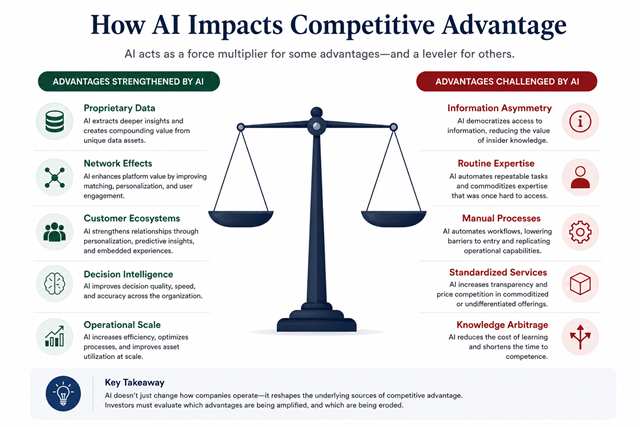
Every successful business is built upon some form of competitive advantage. That advantage may come from proprietary data, customer relationships, distribution networks, operational scale, brand strength, specialized expertise, or network effects. Regardless of the source, the objective is the same: creating a position that competitors struggle to replicate.
What makes the current AI cycle particularly interesting is that it does not affect all competitive advantages equally.
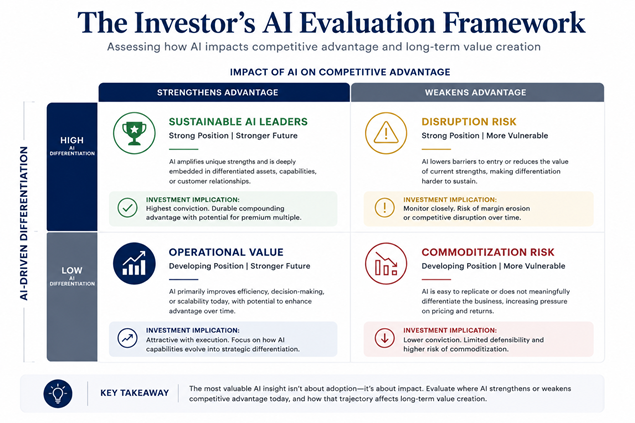
Over the past year, one pattern has become increasingly difficult to ignore. AI reinforces certain advantages while placing pressure on others.
Consider organizations that possess unique datasets accumulated over many years. AI can increase the value of those assets by enabling better insights, stronger personalization, and more effective decision-making. In these situations, AI strengthens an advantage that competitors cannot easily replicate because the underlying data remains unique.
A similar dynamic can emerge in businesses with powerful customer ecosystems or network effects. AI allows these organizations to extract greater value from existing relationships and interactions, creating a reinforcing cycle that can widen the gap between market leaders and challengers.
The picture looks very different for businesses whose differentiation relies heavily on information asymmetry or routine expertise.
Historically, specialized knowledge created barriers to entry because acquiring that knowledge required time, experience, and access. AI changes that equation. While expertise remains valuable, access to information is becoming dramatically easier. Activities that once depended on scarce knowledge can increasingly be supported, accelerated, or partially automated by AI systems.
This does not mean expertise becomes irrelevant. It means organizations can no longer assume that expertise alone will provide the same level of protection it once did.
Many leadership teams continue to view AI primarily as a productivity initiative. That perspective is understandable, but it may also be incomplete.
Productivity gains and competitive advantage are not always the same thing. An organization can become more efficient while simultaneously becoming easier to compete against.
For leaders and investors, that possibility deserves far more attention than it currently receives.
Why This Matters for Long-Term Value Creation
The importance of this shift becomes clearer when viewed through a longer-term lens.
Short-term performance can often mask structural changes taking place beneath the surface of a business. Revenue may continue to grow. Margins may remain healthy. Customer retention may appear stable. Yet the underlying sources of competitive advantage may already be changing.
That is what makes the current AI cycle so significant. Unlike many previous technology trends, AI has the potential to influence nearly every aspect of how organizations compete. It can change customer expectations, accelerate innovation cycles, lower barriers to entry, reshape industry economics, and alter the value of assets that were once considered highly defensible.
For decision-makers evaluating long-term opportunities, the challenge is not simply understanding where AI is being adopted. The challenge is understanding how AI changes the competitive landscape over time.
Organizations that use AI to deepen customer relationships, improve decision quality, strengthen proprietary advantages, and accelerate innovation may emerge with stronger market positions than before. Others may discover that AI makes it easier for competitors to replicate capabilities that were once difficult to match.
The distinction is subtle, but it can have profound implications for long-term value creation.
The Questions That Matter Next
The first wave of AI conversations focused largely on adoption. Does the organization have an AI strategy? Has leadership invested in AI capabilities? Are AI initiatives underway?
Those questions were useful when AI adoption itself was uncertain. Today, they reveal far less than they once did.
The more revealing questions focus on outcomes rather than implementation.
How does AI affect customer loyalty?
Does it strengthen pricing power?
Does it improve decision-making?
Does it reinforce the organization's ability to compete?
Can competitors access the same capabilities with relative ease?
The answers provide a clearer picture of whether AI is creating lasting strategic value or simply improving operational efficiency.
One of the risks in today's market is that AI adoption is being mistaken for AI differentiation.
They are not interchangeable concepts. A company can invest heavily in AI, launch multiple initiatives, and still find itself operating in a more competitive market than before.
The objective should not be to determine whether AI exists within the business. The objective should be to understand how AI alters the factors that influence future growth, profitability, and competitive positioning.
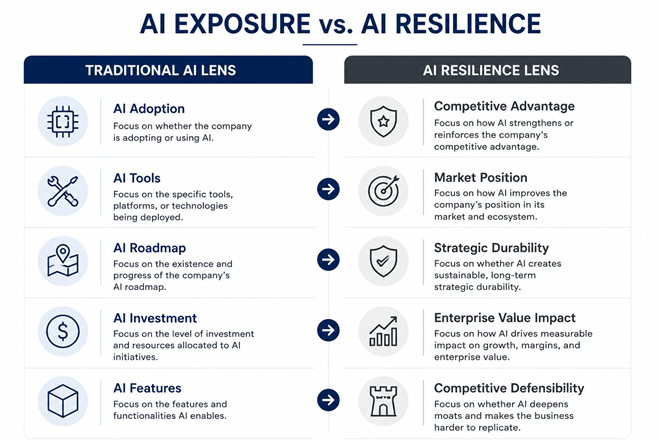
|
Traditional AI Question |
Strategic Question |
|
Does the organization use AI? |
How does AI affect its competitive position? |
|
Has leadership developed an AI strategy? |
Does AI strengthen or weaken barriers to entry? |
|
Are AI initiatives underway? |
Does AI improve customer value and retention? |
|
Is AI reducing costs? |
Does AI increase long-term differentiation? |
|
Is the organization investing in AI capabilities? |
Does AI improve resilience and adaptability? |
The organizations most likely to create enduring value may not be those investing the most in AI. They may be the ones using AI in ways that competitors struggle to replicate.
The Next Investment Advantage May Come From Measuring AI Resilience
Industry analysts are increasingly recognizing that AI is moving beyond experimentation and into the core of how organizations operate. Forrester has described this transition as a shift toward AI-enabled operating models that influence growth, competitiveness, and resilience.
That observation is particularly relevant because it changes the nature of the conversation. When a technology is still experimental, the primary question is whether adoption will occur.
Once adoption becomes widespread, the more important question becomes who benefits disproportionately from it. The distinction may appear subtle, but it has significant implications.
Research from PwC highlights this challenge. While a majority of CEOs report efficiency gains from generative AI initiatives, substantially fewer report meaningful revenue growth attributable to those investments. The gap highlights a reality that many organizations are beginning to encounter firsthand. Productivity improvements are relatively easy to achieve. Sustainable competitive advantage is considerably harder.
This is where the concept of AI resilience becomes useful. AI exposure measures participation in a trend.
AI resilience measures an organization's ability to strengthen its position as that trend reshapes the market around it. One framework tells us who is adopting the technology.
The other helps identify who is likely to emerge stronger because of it.
History suggests that every major technology cycle eventually changes the signals people rely upon. During the internet era, connectivity mattered. During the cloud era, scalability mattered. The AI era may ultimately be defined by a different characteristic altogether: the ability to preserve and strengthen competitive advantage in a market where powerful technology is available to everyone.
Organizations that recognize this shift early are likely to evaluate opportunities differently. Rather than focusing exclusively on who is adopting AI, they will spend more time understanding how AI changes industry structure, competitive dynamics, and the durability of economic advantages.
Those insights may prove far more valuable than adoption metrics alone.
Looking Beyond AI Adoption
The business community has spent the better part of two years trying to understand who is exposed to artificial intelligence. That was an important exercise, and in many ways it remains necessary.
However, exposure alone is becoming an increasingly incomplete measure of future value creation. As AI capabilities become more accessible, the conversation is naturally shifting toward a more fundamental question: which organizations become stronger as a result of AI, and which become more vulnerable?
The answer will vary by industry, business model, and competitive landscape. Yet the distinction may ultimately determine where the next generation of market leaders emerges.
Understanding AI adoption is only the starting point. The more important challenge is determining how AI reshapes competitive dynamics, influences disruption risk, and affects the durability of advantage over time.
As access to AI becomes increasingly universal, the organizations that stand apart will not necessarily be those investing the most in the technology. More often, they will be the ones using AI to strengthen the characteristics that competitors find hardest to replicate.
The market has spent the past two years measuring AI exposure. The next decade may be defined by something far more important: AI resilience.
About Evermethod AI
Evermethod AI helps organizations move beyond surface-level AI exposure analysis to understand how AI is reshaping industries, influencing competitive positioning, and creating both opportunities and risks across markets.
Because in a world where access to AI is increasingly universal, the most important signal is no longer adoption. It is resilience.
References
· PwC, Global Artificial Intelligence Study
· PwC, 28th Annual Global CEO Survey
· Forbes Research, The Winning AI Strategies of High-Growth Companies
· Forbes Research, CxO Growth Survey
· Forrester Research, Top 10 Emerging Technologies for 2025
%2013.png)