
Author : Evermethod, Inc. | November 16, 2026


Rethinking Competitive Advantage as AI Advances
A company's competitive position can weaken when technology makes its products easier to replicate. Software businesses that once relied on costly development and specialized capabilities may now face competitors that can build similar features faster and at a lower cost. For investors, this raises important questions about pricing power, margins, and valuation assumptions.
AI can also create opportunities to grow revenue, improve productivity, and reduce operating costs. The impact depends on what gives a business its competitive advantage and how effectively it adopts the technology. Investors need to understand where AI could weaken existing strengths, where it could create new sources of value, and whether the company can sustain its performance over time.
1. Assess How AI Could Affect the Company's Business Model
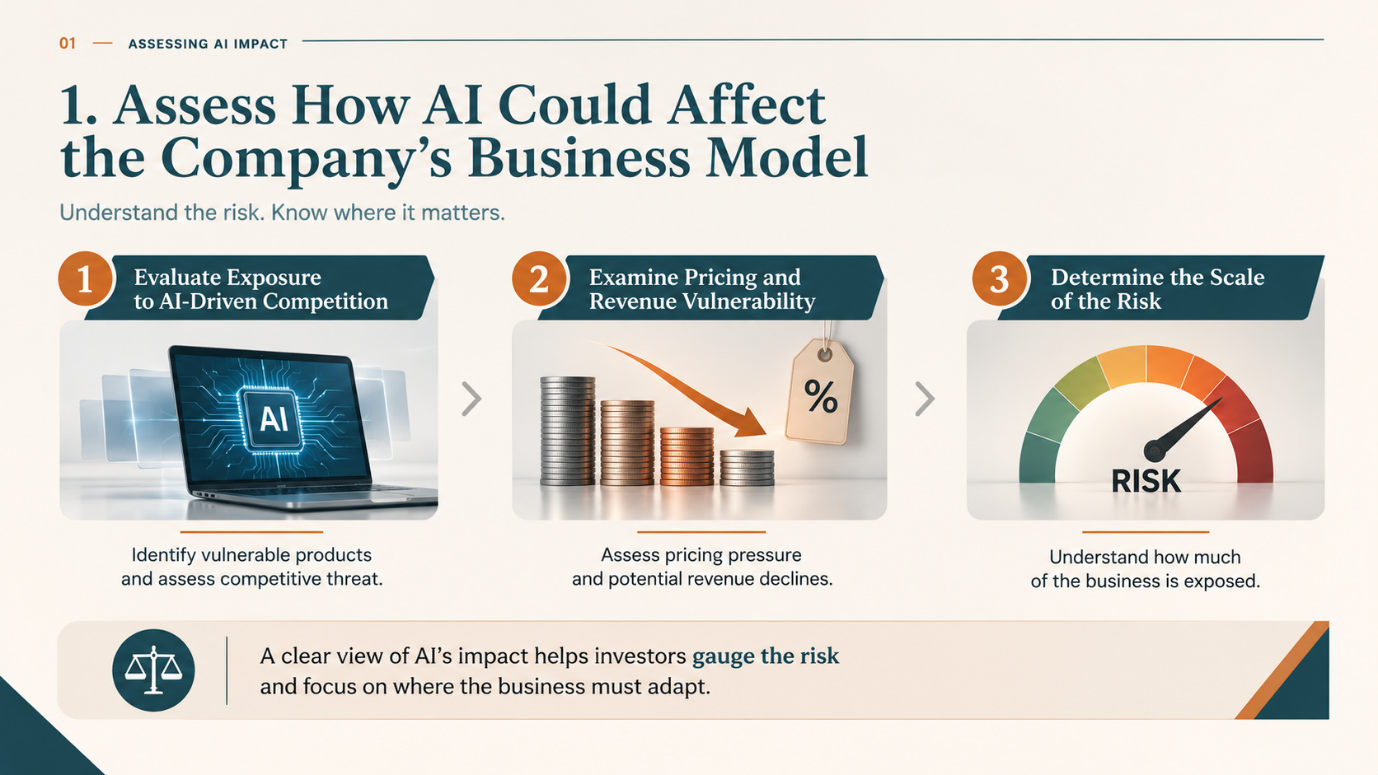
Before estimating AI's potential benefits, investors should understand how it could affect the company's existing revenue and profitability.
Evaluate Exposure to AI-Driven Competition
Investors should examine what customers actually pay for and how easily competitors could reproduce it. A software company whose main advantage lies in a narrow set of features may face greater pressure than one managing complex operations across an organization.
The assessment should identify vulnerable products, their contribution to revenue, and the availability of credible alternatives. This helps establish whether AI presents a limited product challenge or a broader threat to the business model.
Examine Pricing and Revenue Vulnerability
A company can face financial pressure even when customers continue using its products. As competing solutions become more affordable, customers may negotiate lower prices or expect additional capabilities without paying more.
Pricing structures can create further exposure. For example, a software provider charging per user could lose revenue if AI automation reduces the number of licenses customers need. Investors should examine renewal rates, contract terms, pricing trends, and revenue linked to tasks that AI could automate.
Determine the Scale of the Risk
The extent of the risk depends on how central the affected product is to the customer's operations. Competitors might replicate individual features without matching the wider system, integrations, and industry expertise that make the original product valuable. In other cases, customers may no longer need the solution at all.
Understanding this difference helps investors estimate how much of the business is exposed and how urgently management needs to respond.
2. Determine Whether the Company Has a Durable AI Moat
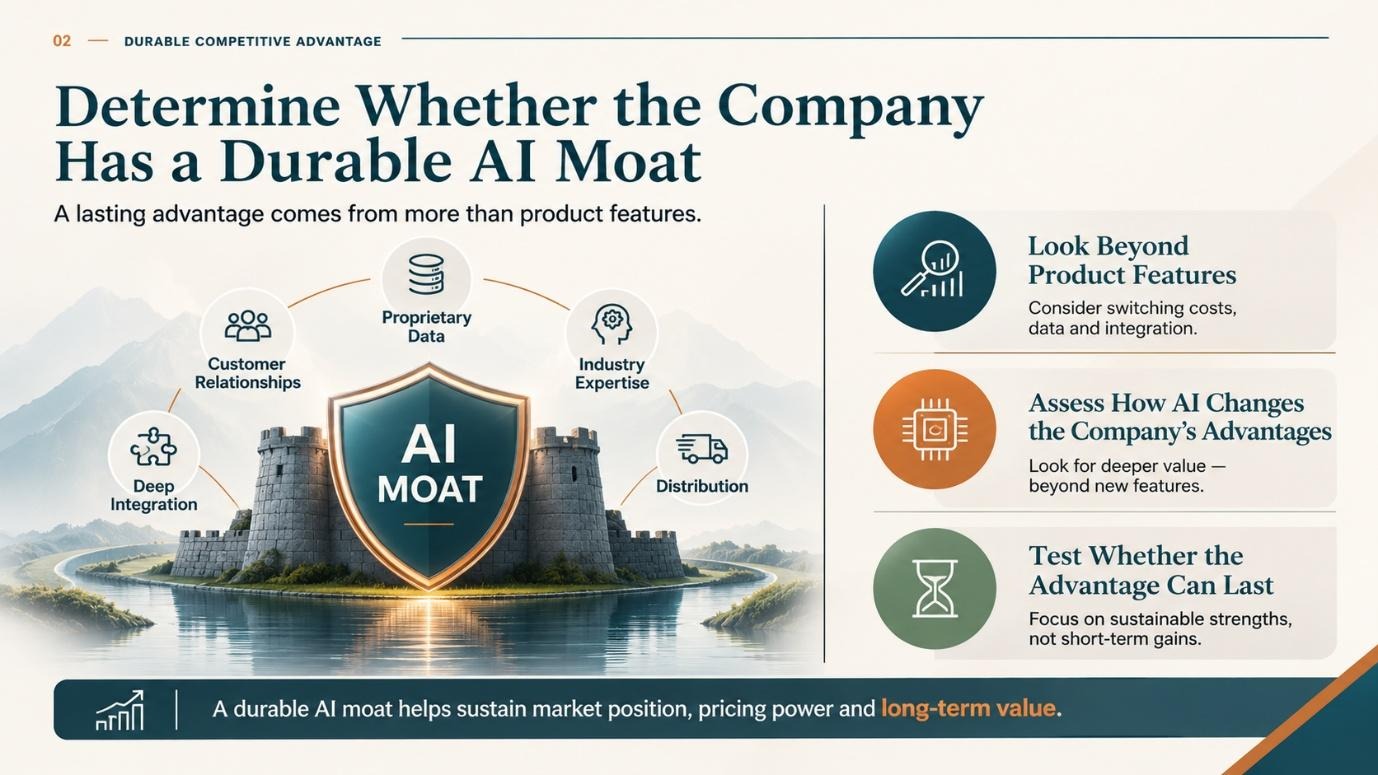
A durable competitive advantage helps a company maintain its position as AI capabilities become more widely available. It may come from proprietary data, industry expertise, customer relationships, distribution, or integration into essential workflows.
Access to AI technology alone rarely provides lasting differentiation if competitors can use the same models and tools. Investors need to examine what makes the company's offering difficult to reproduce or replace.
Look Beyond Product Features
Consider a software company that manages financial reporting or supply chain operations. A competitor may be able to reproduce some of its features, but replacing the existing system could require migrating years of data, retraining employees, changing established processes, and reconnecting other applications.
These switching costs can make the business harder to displace than its feature list suggests. Investors should examine how deeply the product is embedded in daily operations and what customers would need to change to replace it.
Proprietary data can also create an advantage when it is relevant, usable, and capable of improving the product in ways competitors cannot easily match. A large database alone, however, does not guarantee defensibility.
Assess How AI Changes the Company's Advantages
Established industry knowledge can help a company apply AI more effectively than a new entrant. The company may understand customer requirements, operational exceptions, and regulatory constraints that a competitor would take time to learn.
Investors should look for evidence that AI improves the customer experience or enables the company to solve problems more effectively. Can the product complete work that previously required substantial manual effort? Are customers receiving enough additional value to justify continued spending?
These outcomes offer stronger evidence of progress than the number of AI features a company has launched.
Test Whether the Advantage Can Last
An AI feature that differentiates a company today may become standard across its market within months. Investors should therefore distinguish temporary product improvements from advantages that competitors would struggle to reproduce.
A stronger position exists when AI builds on specialized data, trusted customer relationships, or deep operational integration. Sustained demand, customer retention, and pricing power can help validate that position, although none guarantees long-term protection.
Investors should also assess whether AI can improve the company's own economics, creating opportunities to strengthen performance rather than simply defend existing market share.
3. Identify Where AI Can Improve Business Performance
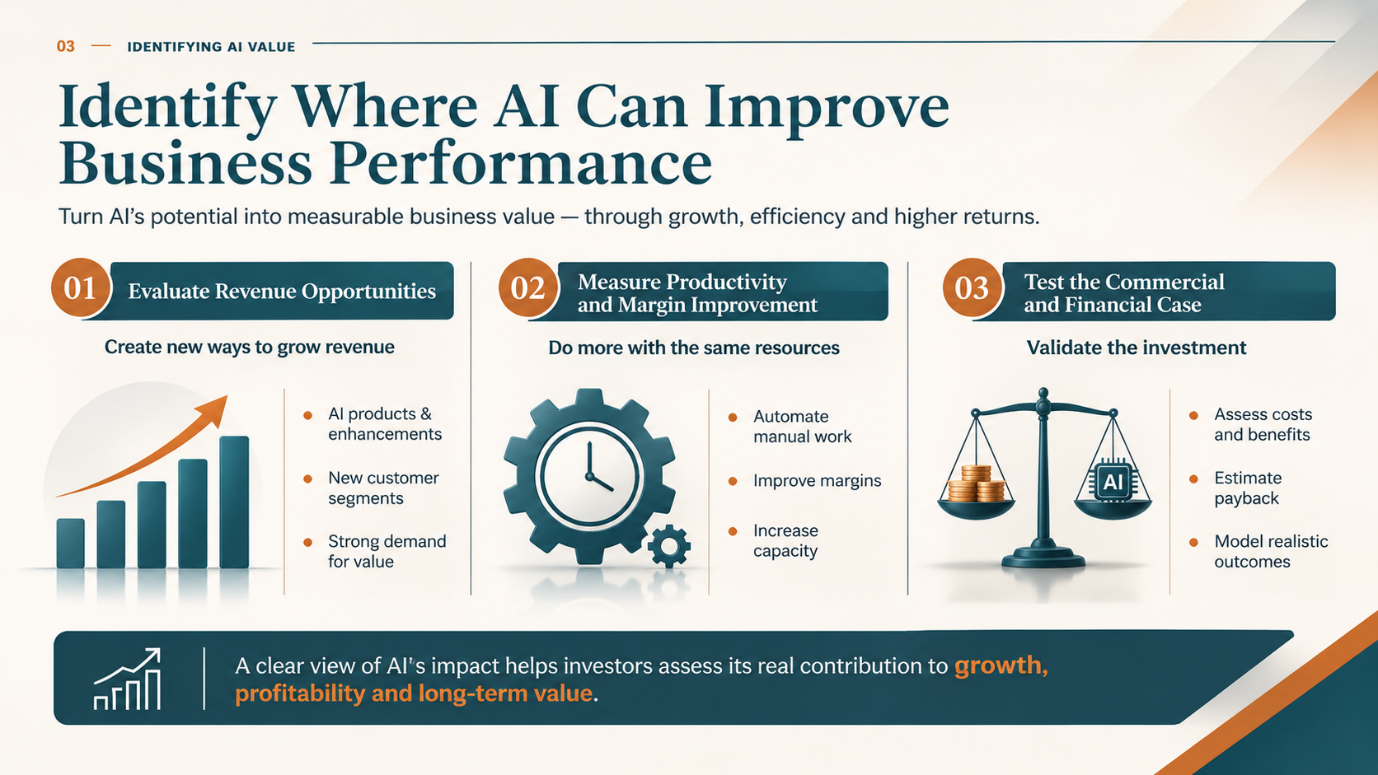
AI can support revenue growth, improve service delivery, and reduce operating costs. The investment opportunity depends on whether these benefits are commercially meaningful and achievable within a realistic timeframe.
Evaluate Revenue Opportunities
Companies may introduce AI-enabled products, add paid capabilities to existing offerings, or serve customers they could not previously support profitably. Investors should test whether these opportunities reflect genuine demand rather than management's expectations alone.
Useful evidence includes customer willingness to pay, successful pilots that convert into contracts, and clear demand for the problem being solved.
Pricing deserves particular attention. If competitors offer similar AI capabilities as standard features, customers may resist paying extra. AI could then be necessary to retain customers rather than a significant new revenue stream. That difference should be reflected in growth forecasts.
Measure Productivity and Margin Improvement
AI can reduce repetitive work, speed up service delivery, and allow employees to handle larger workloads. Businesses with substantial manual processes may be able to improve margins or support additional customers without increasing costs at the same rate.
Investors should ask management to identify the processes expected to change, their current costs, and the improvements it expects to achieve. The analysis should also include implementation, software, training, and maintenance expenses.
Time saved does not automatically translate into lower costs. Productivity gains create financial value when the company reduces spending, increases output, improves service quality, or uses existing capacity more effectively. The investment case should explain how those gains will affect business performance.
Test the Commercial and Financial Case
A promising AI initiative may still deliver weak returns if implementation is expensive or integration proves difficult. Investors need a clear view of the expected benefits, required investment, and time to payback.
For example, automating part of a service operation could improve margins if the business handles more customers with its existing team. If demand remains limited and staffing costs do not change, the financial benefit may be smaller than expected.
4. What Should Investors Measure Before Making an Investment Decision?
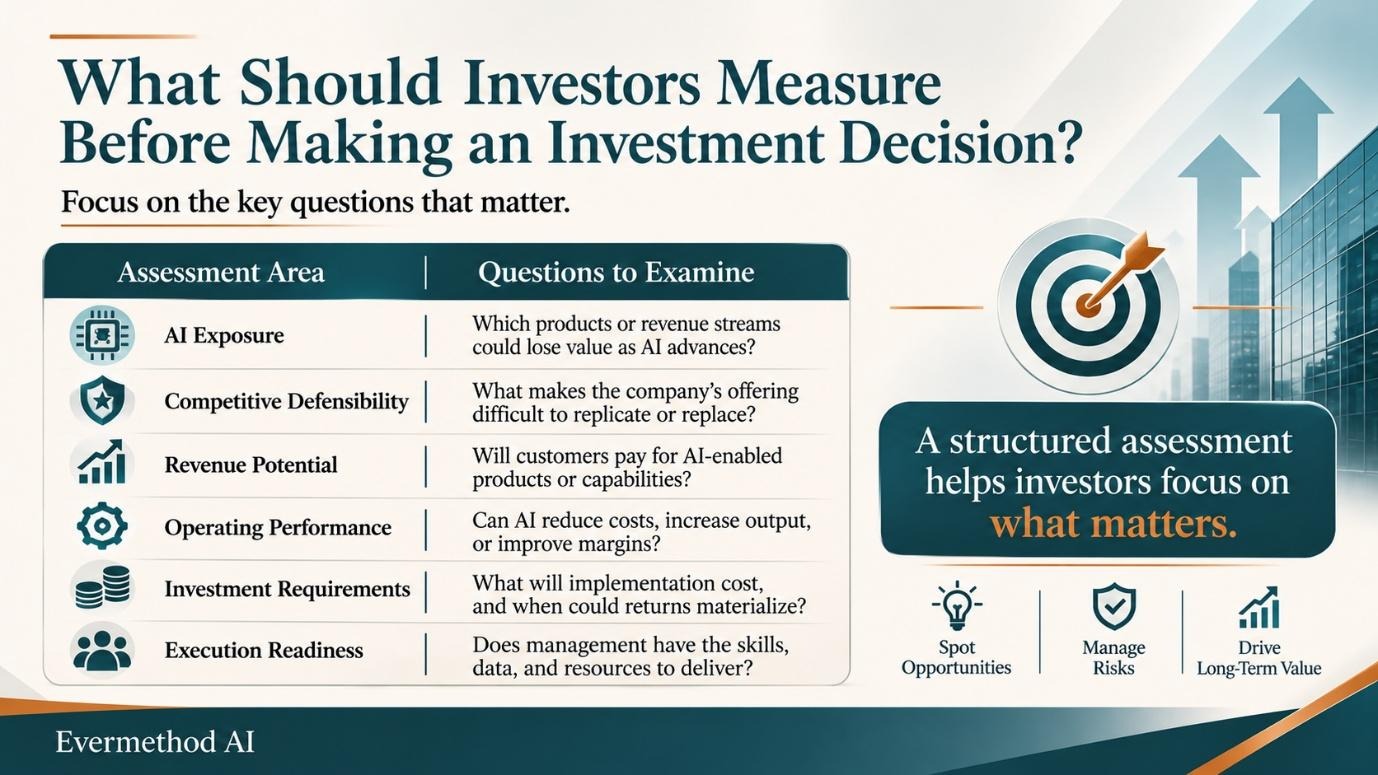
Investors need a focused assessment of the company's exposure, competitive advantages, expected returns, and ability to execute.
Connect the Assessment to Valuation
AI can affect both a company's growth prospects and the risks reflected in its valuation. If its products are becoming easier to replicate, investors should examine whether forecasts account for potential price reductions, customer losses, or additional spending to defend market share.
Companies with strong customer relationships and credible AI initiatives may also have opportunities to outperform current expectations. However, projected gains should be weighed against implementation costs, competitive responses, and management's ability to deliver results.
Establish Priorities for Portfolio Companies
For existing portfolio companies, the assessment should translate into specific operating priorities. One business may need to protect a vulnerable product line, while another may have greater potential to launch AI-enabled services or automate expensive internal processes.
Each initiative should have a clear owner, timeline, and measure of success. Depending on the objective, relevant indicators might include revenue from new products, service delivery costs, processing times, customer renewal rates, or operating margins.
Regular reviews help investors and company leadership identify which initiatives are delivering results and where resources should be redirected.
Conclusion
AI changes the economics of competition, but its effect depends on what a business offers and why customers continue to choose it. Products that are easy to replicate may face pricing pressure, while companies with specialized knowledge, strong customer relationships, and deeply integrated systems may find new ways to defend and grow their position.
Investors should evaluate whether existing advantages can withstand competitive pressure and whether adopting AI can generate returns that justify the investment. Connecting these questions to customer demand, operating performance, and valuation assumptions provides a more grounded basis for investment decisions.
Turn AI Insights Into Portfolio Value
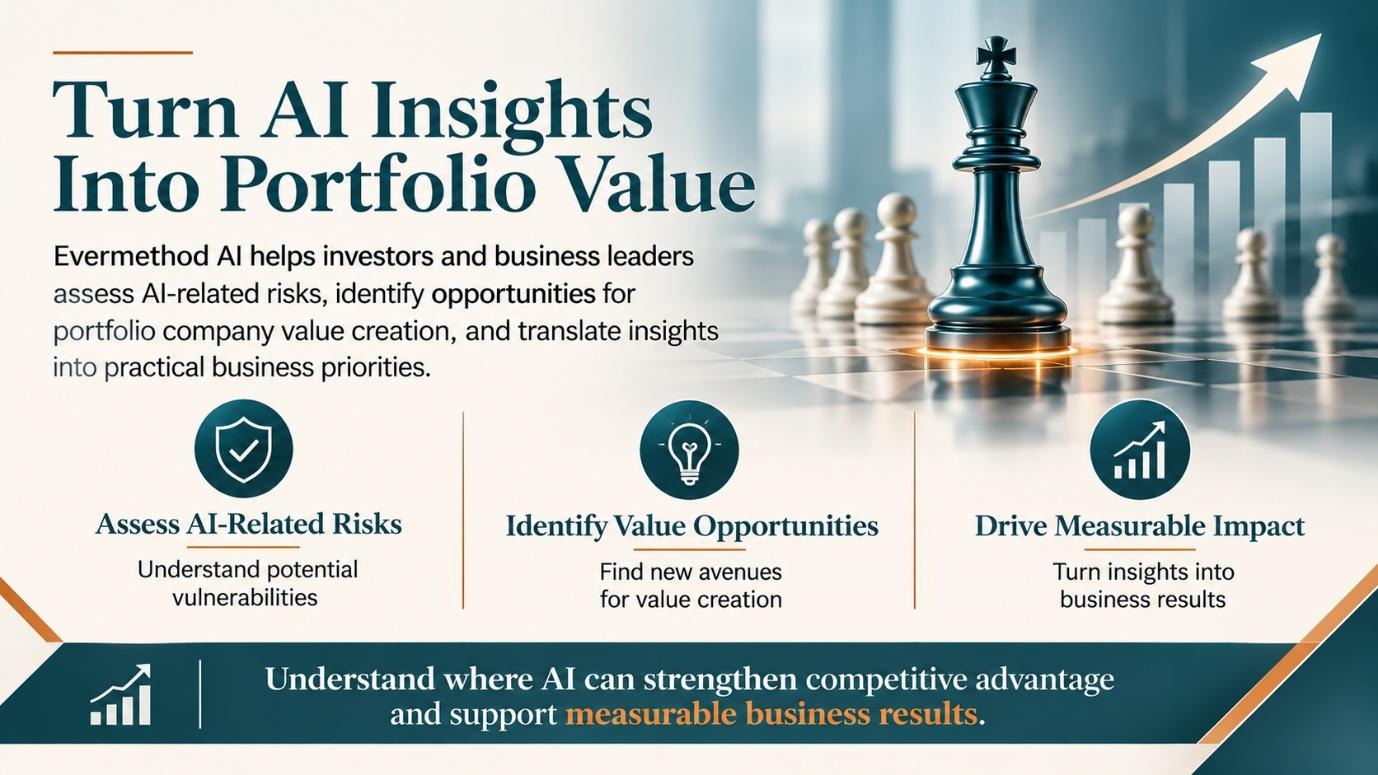
Evermethod AI helps investors and business leaders assess AI-related risks, identify opportunities for portfolio company value creation, and translate insights into practical business priorities. Understand where AI can strengthen competitive advantage and support measurable business results.