
Author : Evermethod, Inc. | August 24, 2026
.png/preview.png?t=1721195409615)

AI is moving from a technology consideration to a business-model consideration. For companies across industries, it is beginning to influence how products are built, how services are delivered, how customers buy, how costs scale, and where competitive advantages come from. That makes AI increasingly relevant to diligence, but it also requires a broader lens than reviewing infrastructure, data architecture, or technical capabilities.
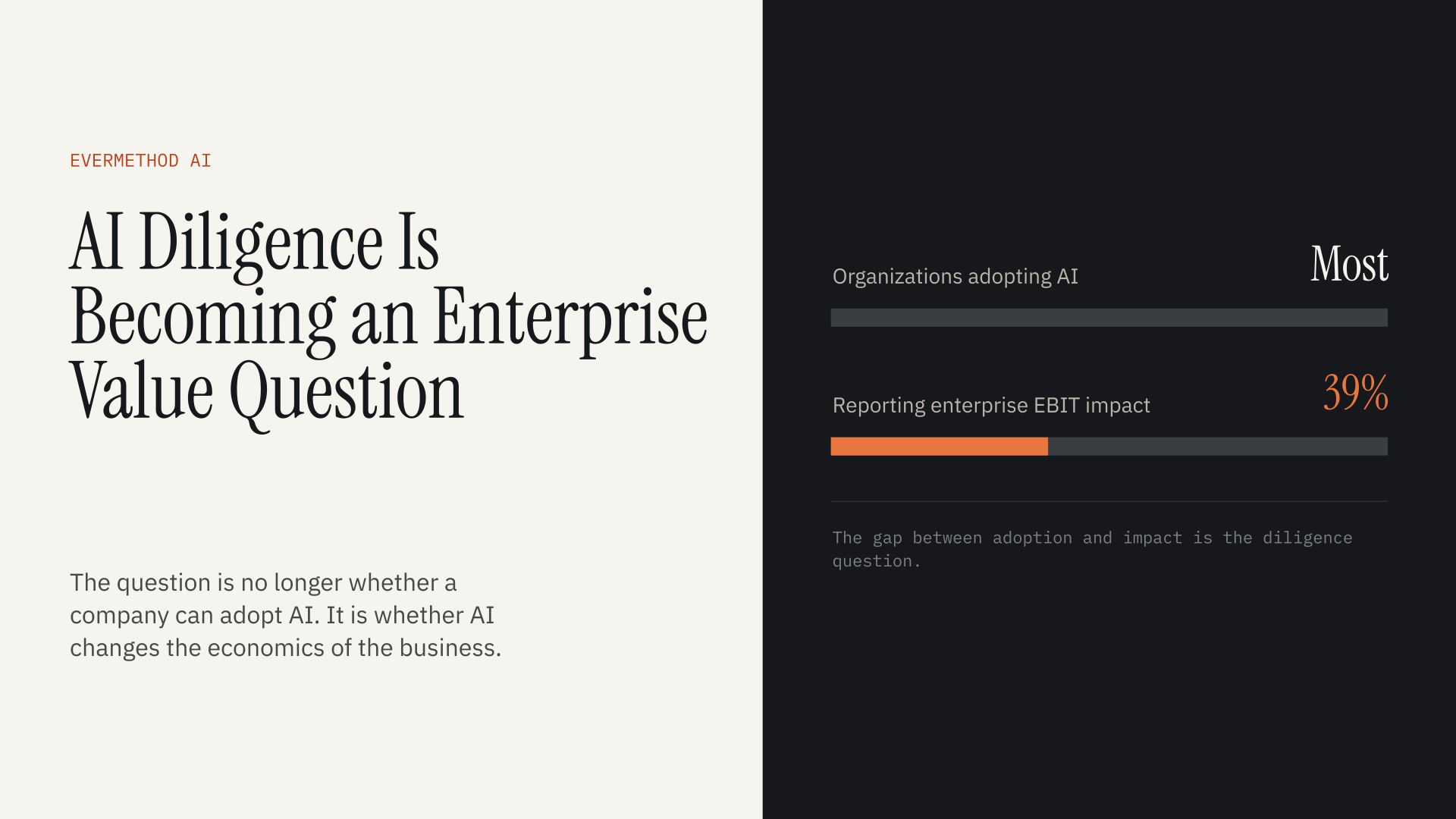
The scale of the opportunity makes this shift difficult to ignore. McKinsey estimates that generative AI could create $2.6 trillion to $4.4 trillion in annual economic value across the use cases it analyzed. Yet its 2025 global AI survey found that only 39% of organizations reported an enterprise-level EBIT impact from AI, while nearly two-thirds had not yet begun scaling AI across the organization.
The gap between AI adoption and measurable business impact is therefore becoming an important diligence question. The issue is no longer simply whether a company can adopt AI, but how AI could change the economics of the business and whether management can translate that change into durable value.
AI Diligence Has to Look Beyond Infrastructure
Technology infrastructure remains an important part of diligence, but it is only the starting point for understanding AI's impact on a business. A company may have modern systems, strong data, and capable engineers while still being vulnerable if AI makes its core offering easier to replicate or changes what customers are willing to pay for.
The opposite can also be true. A company that has not yet deployed AI extensively may have significant opportunities to improve margins, accelerate product development, create new revenue streams, or serve customers differently. The investment question therefore requires a connection between technical readiness and business economics.
IBM's 2025 CEO study reinforces why infrastructure remains relevant within this broader picture. Among 2,000 CEOs surveyed across 33 countries and 24 industries, 61% said their organizations were actively adopting AI agents and preparing to implement them at scale, while 68% identified integrated enterprise-wide data architecture as critical for cross-functional collaboration.
The point is not that infrastructure has become less important. Rather, diligence needs to establish what that infrastructure enables and how those capabilities translate into economic outcomes.
AI Exposure Is Becoming a Business-Model Question
AI can affect a company well beyond its technology organization. Revenue may come under pressure if customers can achieve the same outcome through AI at a lower cost, while pricing power may weaken if previously differentiated capabilities become easier to reproduce. At the same time, AI can reduce operating costs by changing how software is developed, customer service is delivered, or internal processes are managed.
This makes AI exposure a multidimensional question. The assessment needs to consider which revenue streams could be disrupted, where margins could improve, how customer behavior might change, and which sources of differentiation are likely to remain defensible.
The competitive environment matters just as much. A company that successfully reduces its own costs through AI may still face pressure if competitors achieve similar efficiencies and pass those savings to customers. Likewise, an AI-native entrant may approach an established market with a fundamentally different cost structure.
McKinsey's 2025 research found that 62% of respondents were at least experimenting with AI agents, indicating that AI is increasingly moving from isolated productivity applications toward more autonomous business processes. For diligence, that raises a broader question: how resilient is the company's competitive position if AI adoption accelerates across its market?
AI Value Creation Deserves Equal Attention
Focusing exclusively on disruption can be just as incomplete as focusing exclusively on technology readiness. AI can create substantial opportunities to improve both the revenue and cost sides of a business.
McKinsey estimates that approximately 75% of the potential value from the generative AI use cases it analyzed is concentrated in customer operations, marketing and sales, software engineering, and research and development. These areas illustrate why AI value creation should extend beyond a narrow focus on workforce automation.
For one company, the opportunity may be to reduce the cost of serving customers. For another, it may involve increasing sales productivity or launching hi AI-enabled products. A software business could use AI to accelerate development while also redesigning its product around new customer workflows. The most important opportunities are those capable of changing the economics of the business rather than simply adding another productivity tool.
This distinction is important because AI use does not automatically produce enterprise-level financial impact. The 39% EBIT-impact figure in McKinsey's research demonstrates that widespread experimentation can coexist with relatively limited measurable impact at the enterprise level.
The diligence exercise therefore needs to identify which AI opportunities are material, economically credible, and capable of scaling.
The Critical Gap Is Between Value Creation and Value Capture
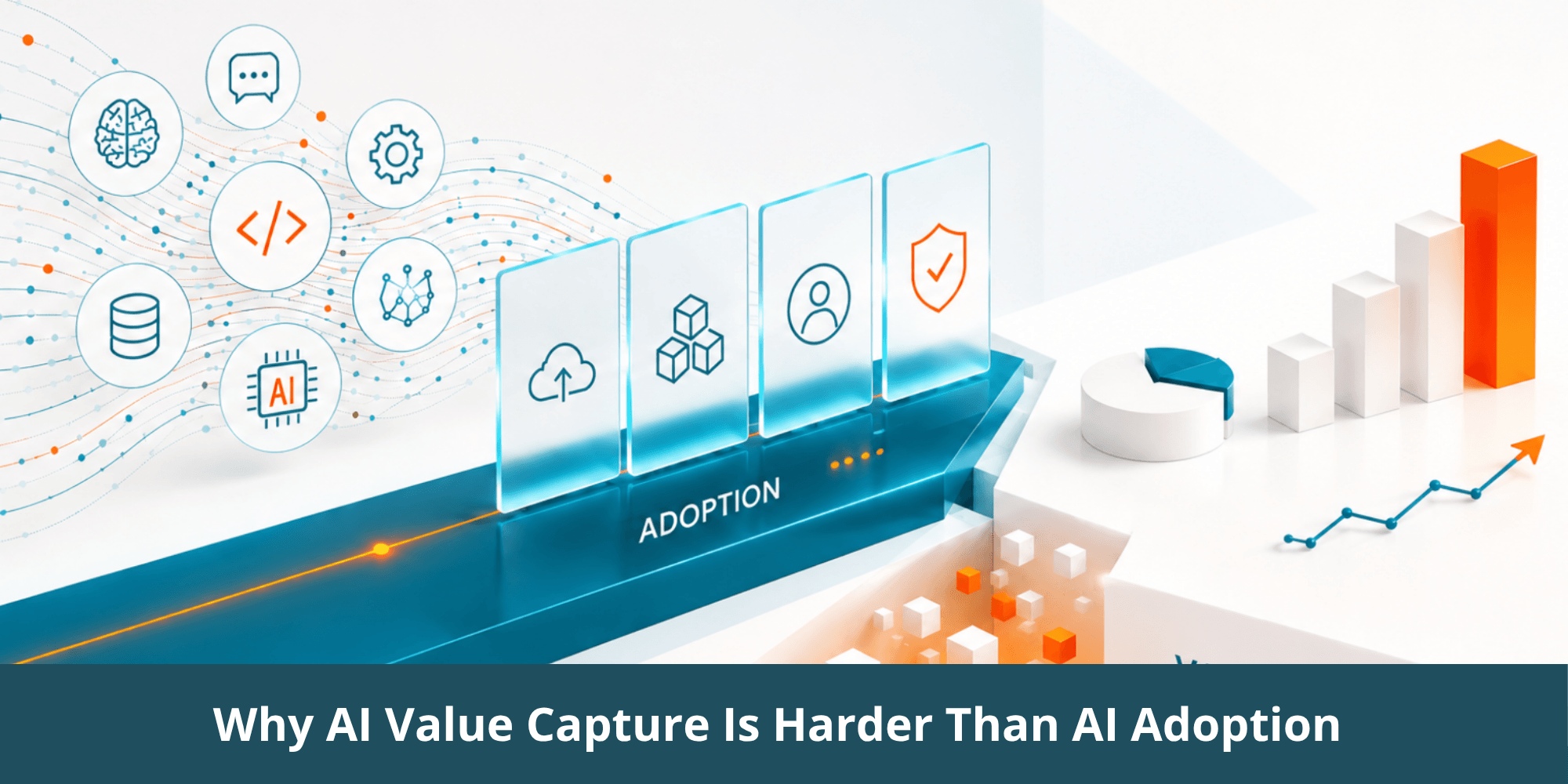
Even when a company identifies a compelling AI opportunity, there is no guarantee that the opportunity will translate into financial results. Capturing value often requires changes to workflows, operating processes, incentives, management practices, and organizational capabilities.
Forrester's 2026 research highlights this challenge, finding that enterprises continue to struggle to convert AI investment and adoption into measurable business impact. The research points to issues including low AI fluency, siloed adoption, difficulty measuring impact, and an emphasis on productivity use cases rather than broader transformation.
This creates an important distinction between AI value creation potential and value capture capability.
From AI Opportunity to Enterprise Value
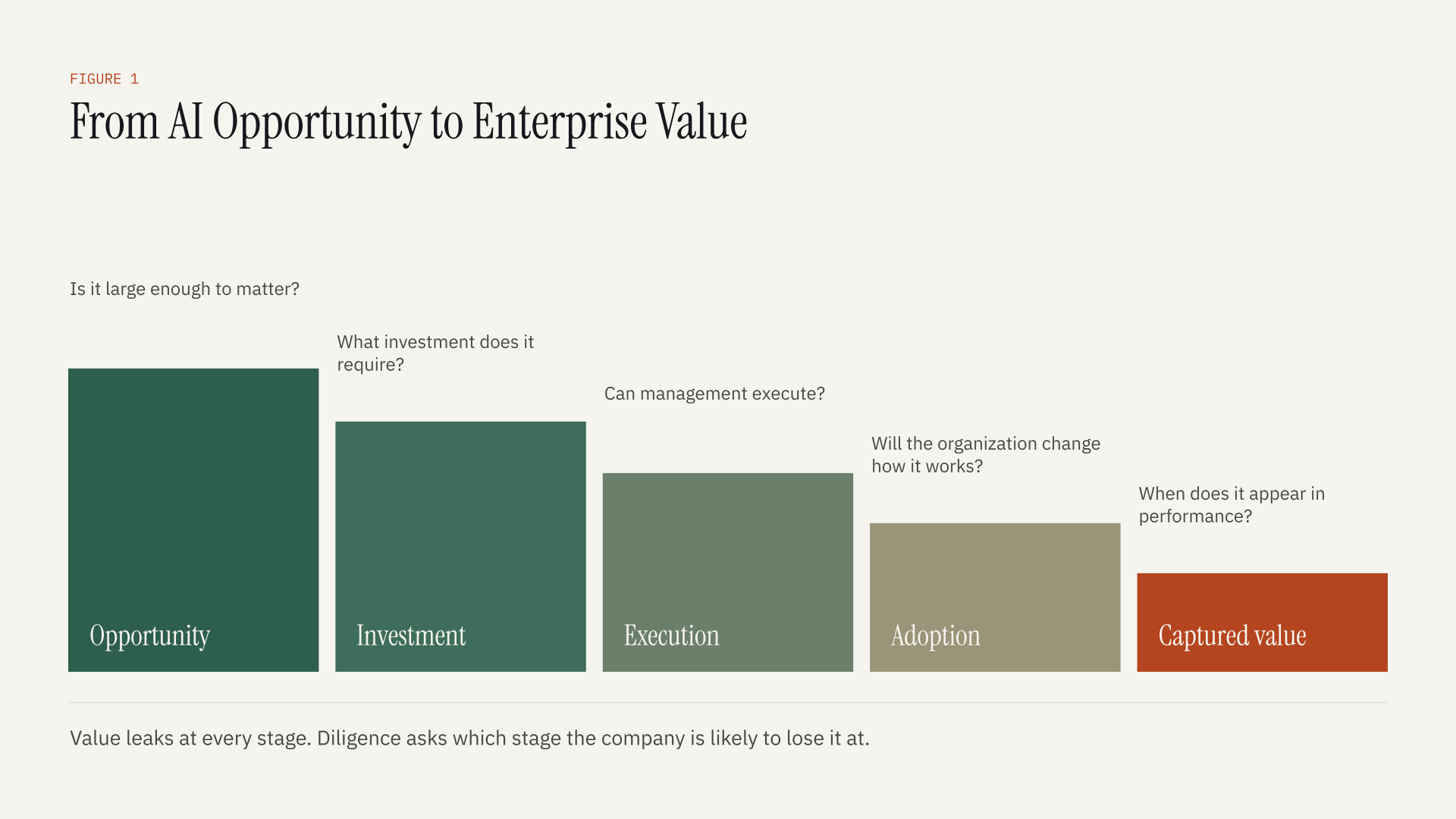
Each stage introduces a different diligence question. Is the opportunity large enough to matter? What investment is required? Can management execute? Will the organization actually adopt the new workflows? How will the financial impact be measured, and when will it appear in the company's performance?
A company with a strong AI roadmap but weak execution capability may therefore have less realizable value than its technology strategy suggests. Conversely, an organization with fewer AI initiatives but strong operational discipline may be better positioned to convert selected opportunities into measurable results.
Connecting AI Diligence to Enterprise Value
The final objective is to connect these findings to the characteristics that determine the future economics of the business. AI diligence should help establish where revenue is most exposed, where margins could expand, which competitive advantages could strengthen or weaken, what investment is required, and whether management has a credible path to capturing the identified opportunities.
AI Diligence Workflow
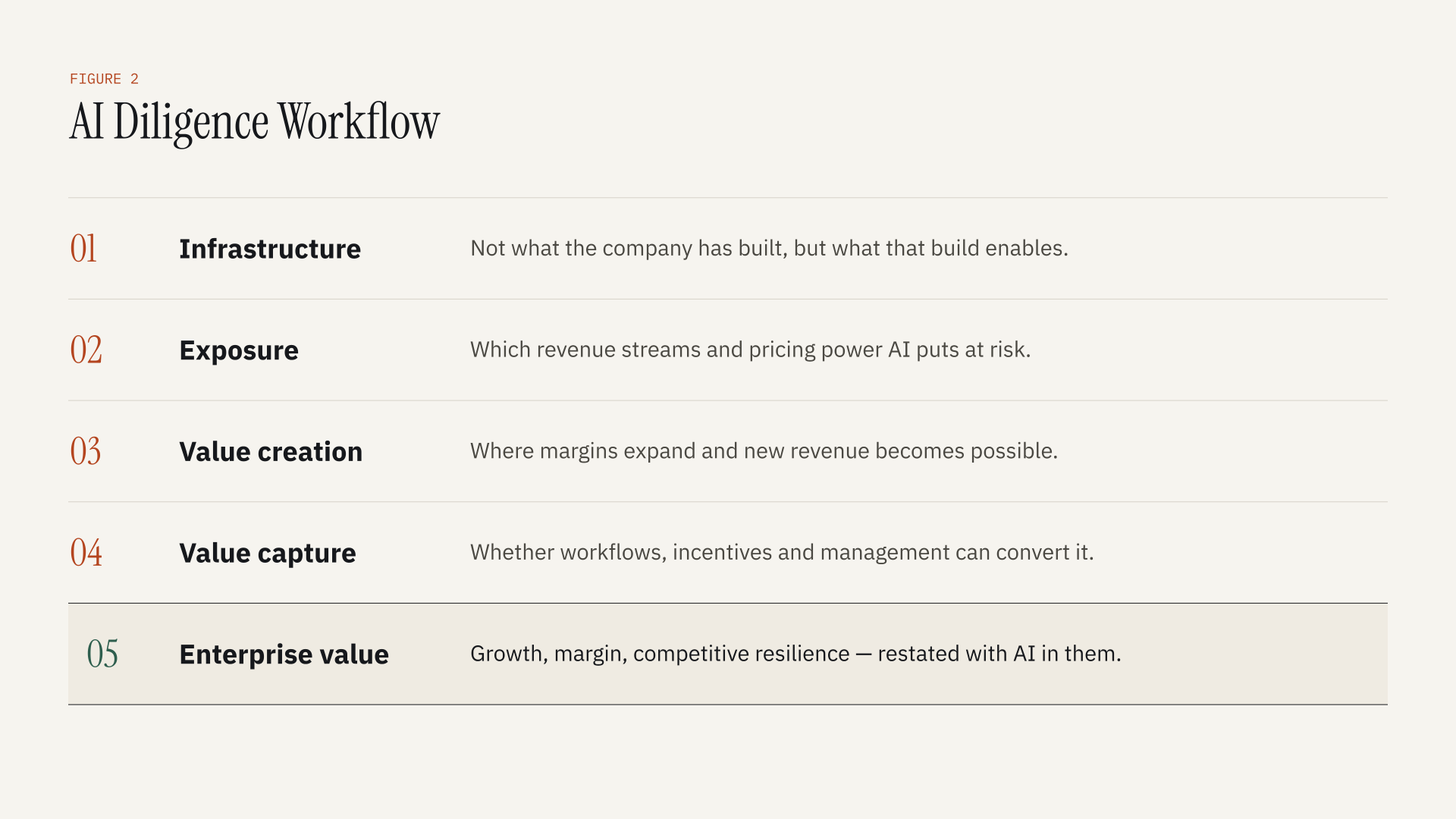
This framework brings together both sides of the equation. AI can threaten existing revenue while creating new revenue opportunities. It can compress costs while simultaneously lowering competitors' costs. It can strengthen a company's moat while making another company's differentiation easier to replicate.
That is why the most useful AI diligence does not simply assign a company an AI-readiness score. It creates a structured view of where value is exposed, where value can be created, how defensible that value is, and what needs to happen for the organization to capture it.
AI Diligence Is Becoming an Enterprise Value Question
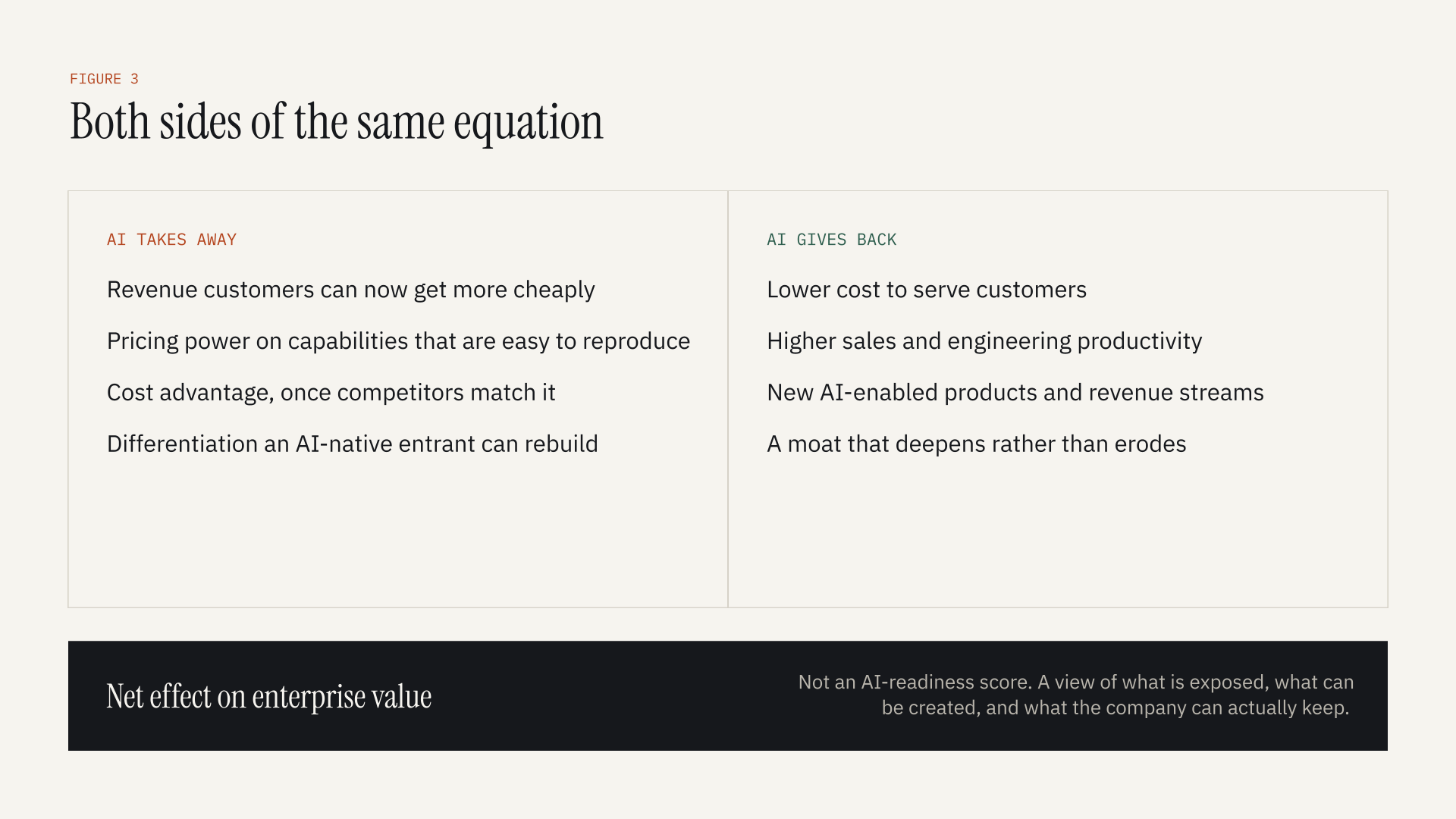
As AI adoption expands, the distinction between technology strategy and business strategy will become increasingly difficult to maintain. The companies that create the most value from AI will not necessarily be those with the largest AI budgets or the most advanced technical infrastructure. They will be the companies that understand where AI changes their economics and can adapt their products, operating models, and competitive strategies accordingly.
For diligence, that means moving beyond the question of whether a company is ready for AI. The more consequential question is how AI could reshape the company's growth, margins, competitive resilience, and ability to create and capture value over time.
That is ultimately what makes AI diligence an enterprise value question.
Go Beyond AI Readiness With Evermethod AI
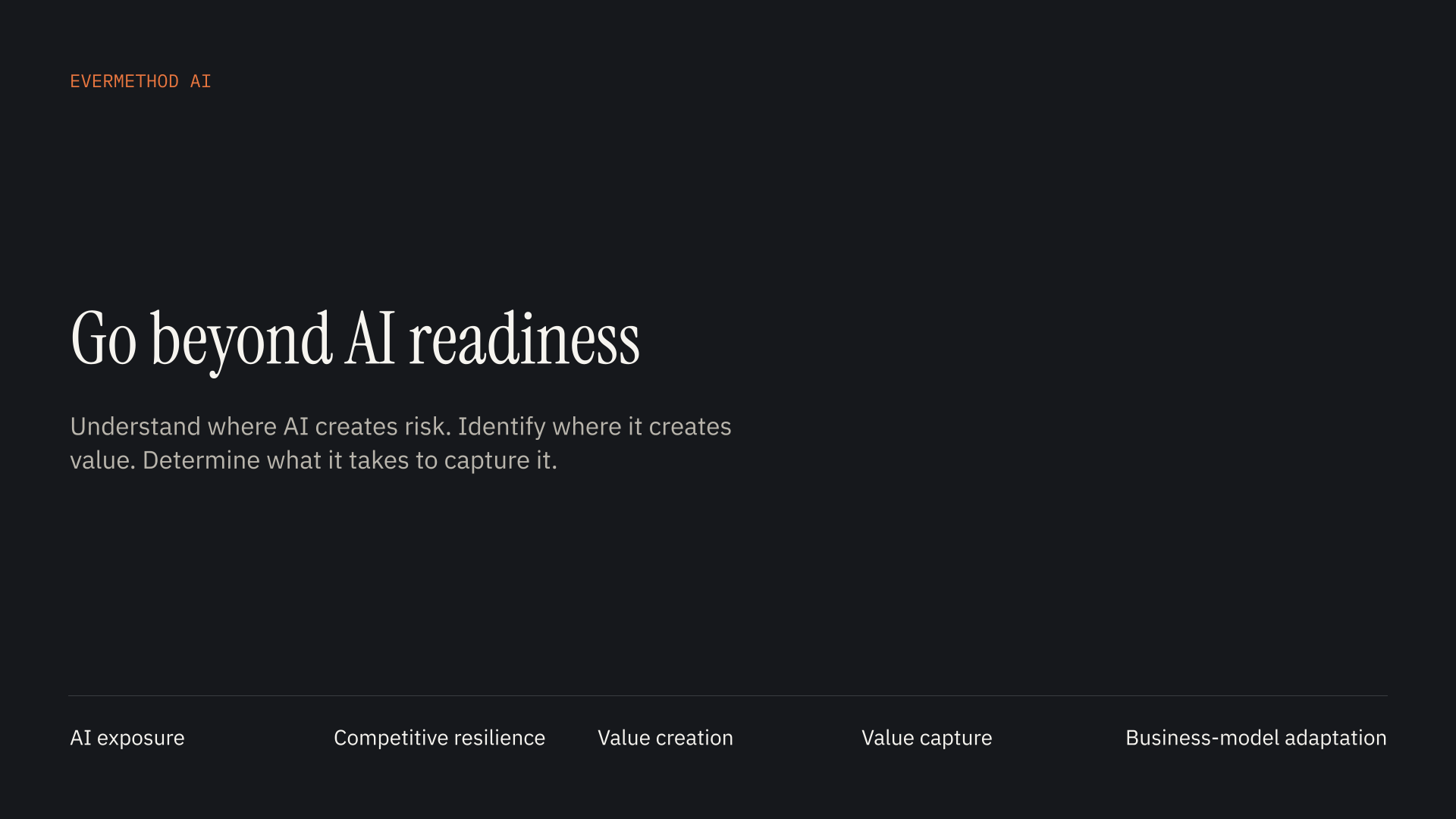
Evermethod AI provides a structured way to assess how AI could reshape a company's economics and competitive position across AI exposure, competitive resilience, value creation, value capture, and business-model adaptation.
Understand where AI creates risk. Identify where it creates value. Determine what it takes to capture it.
References
https://www.mckinsey.com/capabilities/quantumblack/our-insights/the-state-of-ai
%2013.png)
-1%20(1).png)