-1%20(1).png)

Author : Evermethod, Inc. | September 10, 2026
.png/preview.png?t=1721195409615)

Private equity firms have spent the early stages of the AI cycle looking for practical ways to use the technology across their portfolios. Many of those efforts have started with productivity: automating repetitive work, helping employees complete tasks faster, improving customer support, and reducing operating costs.
Those gains are real, but they do not tell the whole value-creation story.
Recent research suggests that “the more significant opportunity may emerge when AI begins to influence the business itself.” McKinsey's 2026 analysis of 471 PE-backed companies found that companies with broader AI adoption had median revenue multiples more than twice those of companies using AI mainly for productivity. The research also found that companies at the highest AI maturity level had a median revenue multiple of 31x between 2023 and 2025, compared with 20x at the preceding level.
The implication for AI for private equity is important. Productivity can improve the current business, while deeper AI adoption can potentially change how the business grows, competes, and creates value.
1. AI for Private Equity Is Moving Beyond Productivity
.webp?width=1500&height=845&name=undefined-Sep-10-2026-03-14-28-7853-PM%20(1).webp)
Productivity is a sensible place to start because the benefits are relatively easy to understand. A customer service team can handle more interactions, a finance team can automate parts of its reporting, and a software team can reduce the time required for development and testing.
L.E.K. Consulting's 2026 PE Pulse found that private equity professionals reported an average 28% productivity improvement from AI use. Investment teams are primarily using AI for research and diligence synthesis, while portfolio companies are using it most often for areas such as customer support and software engineering. At the same time, L.E.K. found that AI has not yet been deployed at scale across PE firms and their portfolios.
That gap is worth paying attention to.
A productivity improvement can reduce costs and support EBITDA. However, if competitors can access the same tools and achieve similar improvements, the advantage may become less distinctive over time.
The more interesting opportunity comes when AI starts changing the economics of the company. McKinsey's research found that PE-backed companies embedding AI into products and services had a median revenue multiple of 20x, compared with 14x for companies focused on operating-model enhancement. Companies that progressed further into AI-enabled business building reached a median multiple of 31x.
These findings do not establish that AI alone caused the valuation differences. They do, however, point to a clear relationship between deeper AI maturity and stronger business outcomes.
For PE investors, that makes the distinction between using AI and creating value through AI increasingly important.
2. Where AI Can Influence Enterprise Value
.webp?width=1500&height=998&name=undefined-Sep-10-2026-03-14-30-3056-PM%20(1).webp)
AI can affect several of the financial and strategic drivers already used in private equity investment analysis.
Revenue
AI can improve sales productivity, customer retention, pricing, personalization, and service delivery. It can also make new products or services commercially viable.
This is becoming an important area of focus. Grant Thornton's 2026 Private Equity AI Impact Survey found that 46% of PE leaders are scaling AI across functions, but only 24% report revenue growth from AI.
The gap is revealing. Many firms are investing and experimenting, but a much smaller group can point to measurable revenue outcomes.
Margins
Cost reduction remains an important part of the opportunity. AI can reduce manual work, improve resource utilization, and automate parts of service delivery.
The larger opportunity may come when these improvements change the cost structure of the business. A company that can grow revenue without adding operating costs at the same rate can develop stronger operating leverage, which can have a more meaningful effect on EBITDA than a collection of isolated automation projects.
Scalability
AI can allow companies to handle greater volumes of work without expanding headcount proportionally. This matters particularly in labor-intensive businesses, where growth has traditionally required significant increases in people and operating expense.
McKinsey found that PE-backed companies at its highest AI maturity level had median revenue per employee of $180,000, representing a 52% increase from the preceding level.
Competitive position
AI can improve a company's product, customer experience, speed of innovation, or ability to serve a market. It can also make an existing product easier for competitors to replicate.
That makes competitive analysis a two-sided exercise. Investors need to understand where AI strengthens the company's position and where it could reduce the value of an existing advantage.
Exit value
These effects eventually come together at exit. Growth quality, margins, scalability, differentiation, and defensibility all influence how a buyer views the asset.
BCG's 2026 survey of 100 senior PE investors found that portfolio companies systematically building advanced AI capabilities across functions had nearly twice the return on invested capital of companies that did not. BCG also found that nearly 30% of PE investors now integrate digital levers into diligence, while another 57% consider them core to value-creation planning.
AI is therefore becoming part of a broader value-creation discipline rather than remaining a technology initiative on the side.
3. A Practical AI Value-Creation Test for PE Investors
.webp?width=1500&height=998&name=undefined-Sep-10-2026-03-22-06-5871-PM%20(1).webp)
The strongest AI opportunities can be evaluated using the same investment discipline applied to other value-creation initiatives.
|
Area |
What to Examine |
|
Economic impact |
Potential effect on revenue, EBITDA, cash flow, and capital requirements |
|
Strategic impact |
Changes to differentiation, customer value, and market position |
|
AI exposure |
Products, services, and workflows that could face disruption |
|
Execution |
Data, technology, talent, governance, and management capability |
|
Time to value |
What can realistically be achieved during the hold period |
|
Exit relevance |
Potential effect on growth quality, defensibility, and buyer interest |
The need for this discipline is clear from the current adoption data. Grant Thornton's research shows that 45% of PE leaders are still piloting AI, while 46% are already scaling it across functions. Only 24% report revenue growth from their AI initiatives.
This suggests that the next challenge is less about finding interesting AI applications and more about determining which applications deserve investment, management attention, and scale.
Execution also deserves serious consideration. AI initiatives often require better data, new capabilities, changes to existing workflows, and clear ownership. Without those foundations, an attractive use case can remain stuck at the pilot stage.
Grant Thornton's broader 2026 AI Impact Survey found that organizations with fully integrated AI were nearly four times more likely to report AI-driven revenue growth than organizations still piloting AI, with the figures standing at 58% and 15%, respectively.
For PE firms, that creates a useful distinction between an AI initiative that looks promising on paper and one that can actually become part of the operating model.
4. AI Adoption Does Not Automatically Create a Competitive Advantage
.webp?width=1535&height=1022&name=undefined-Sep-10-2026-03-22-03-4772-PM%20(1).webp)
Most companies can now access similar foundation models, APIs, copilots, and automation tools. That makes basic AI adoption difficult to treat as a durable moat.
The stronger sources of advantage are usually found around the technology. Proprietary data, deep domain expertise, embedded workflows, customer relationships, distribution, and AI-enabled products can make the resulting capability harder to reproduce.
The difference becomes particularly important when considering the future of a portfolio company.
A company may use AI to make employees more productive, while a competitor uses the same technology to redesign its product and capture a larger share of customer spending. Both companies may report successful AI adoption, but the economic consequences can be very different.
McKinsey's 2026 research makes a similar distinction. Its analysis found that the valuation difference between companies using AI opportunistically and those enhancing their operating models was relatively modest, while the move into AI-enabled products and services was associated with a much larger step in median revenue multiples.
There is also a downside that deserves equal attention.
AI can reduce barriers to entry, make certain software features easier to reproduce, lower switching costs, or change customer expectations around pricing. Grant Thornton's 2026 research on PE buyers found that 31% of PE leaders cited competitor moves as the top external pressure driving AI adoption, while buyers are increasingly examining whether AI creates genuine competitive differentiation or weakens an existing moat
That makes AI exposure relevant even when a portfolio company has no immediate plan to deploy the technology itself.
5. Putting AI Into the Investment Lifecycle
.webp?width=1535&height=1022&name=undefined-Sep-10-2026-03-22-11-8926-PM%20(1).webp)
AI value creation becomes more useful when it is connected to the full investment lifecycle.
During due diligence, investors can assess how AI could affect the company's market, products, customers, cost structure, and competitive position. This can uncover opportunities that strengthen the investment case as well as risks that could undermine it.
During investment thesis development, those findings can be connected to specific assumptions around revenue growth, margins, pricing, customer retention, scalability, and competitive advantage. This gives AI a clear place within the financial logic of the deal.
During value-creation planning, the focus can move toward a smaller number of initiatives with measurable economic objectives. The most attractive opportunities are likely to be those where the potential value, investment requirement, execution path, and time to impact are reasonably clear.
During portfolio management, the assessment needs to evolve as technology and competition change. A use case that looks marginal at entry may become important later, while an early AI advantage may disappear as competitors catch up.
At exit, buyers will ultimately want evidence of business impact rather than a list of AI projects. Stronger margins, new revenue streams, greater scalability, improved customer economics, and defensible differentiation provide a much stronger value story.
This broader approach is consistent with the changing priorities of the PE market. McKinsey's 2026 Global Private Markets research found that 53% of LPs ranked a GP's value-creation strategy among their top five manager-selection criteria, making it the third-most-important criterion in the survey.
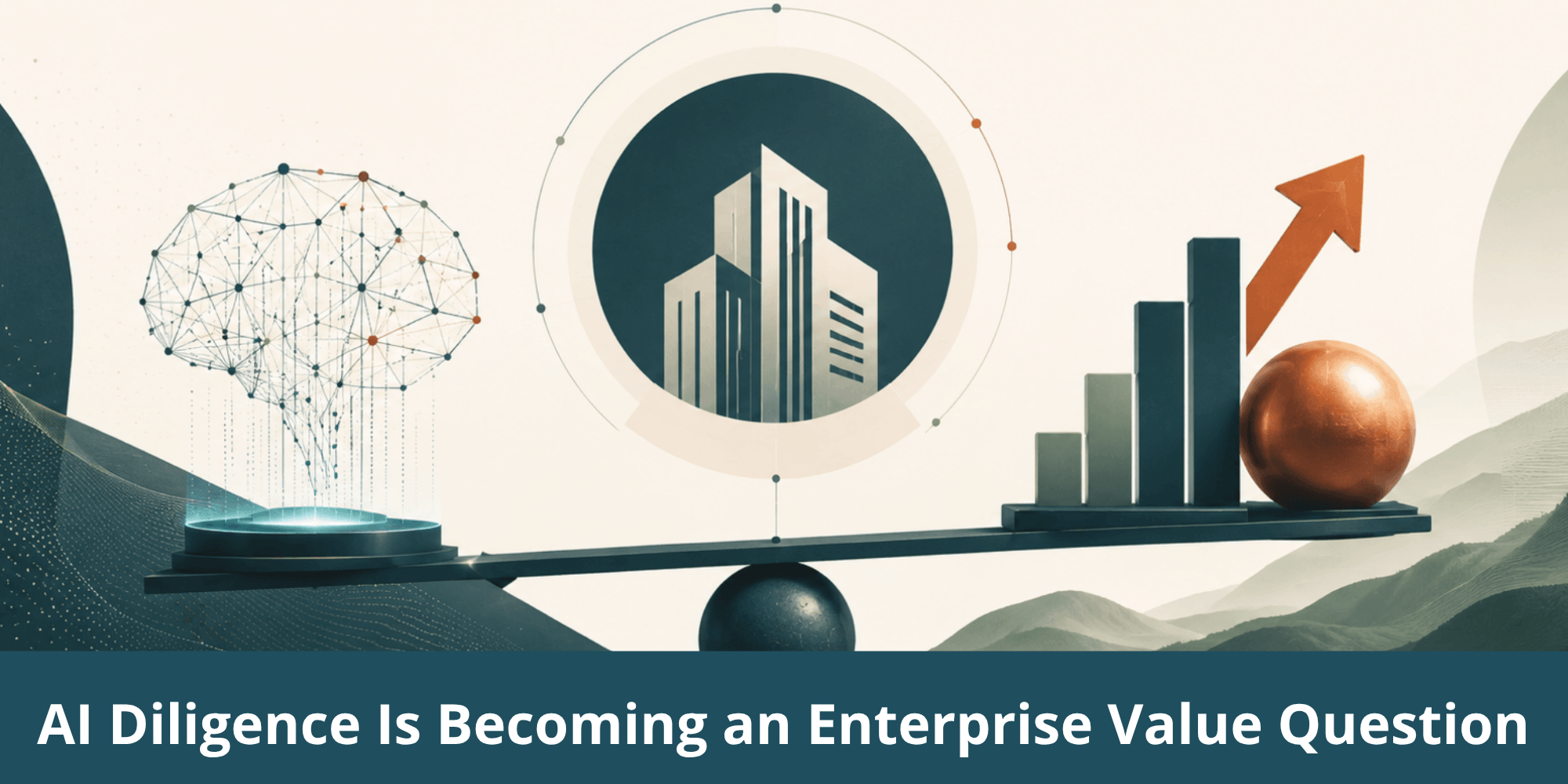
AI therefore deserves a place inside the value-creation conversation because it can influence the underlying economics of the investment, not simply because it is becoming a priority technology.
FAQs
What is AI for private equity?
AI for private equity refers to the use of artificial intelligence across investment analysis, due diligence, portfolio operations, value creation, risk assessment, and exit planning. Its importance is growing as AI begins to influence the economics and competitive position of portfolio companies.
How can AI create value for private equity firms?
AI can support revenue growth, improve margins, increase operating leverage, improve scalability, strengthen customer experiences, and create new products or services. It can also help investors identify areas where AI could threaten an existing business model.
How is AI used in private equity due diligence?
AI can help investors assess AI-related opportunities and risks, examine competitive exposure, analyze business processes, and evaluate how AI could affect revenue, margins, scalability, and long-term defensibility.
How should PE firms evaluate AI opportunities in portfolio companies?
The assessment should consider potential economic impact, execution requirements, investment needed, management readiness, time to value, competitive implications, and relevance to the eventual exit.
Is AI itself a competitive advantage?
Access to AI tools is rarely a durable advantage because competitors can often access similar technologies. Stronger defensibility may come from proprietary data, domain expertise, embedded workflows, customer relationships, distribution, and AI capabilities deeply integrated into the product or operating model.
Why does AI matter for private equity investors?
AI can influence revenue, margins, scalability, competitive dynamics, and exit prospects. These factors can affect both the investment thesis and the value-creation plan for a portfolio company.
See Where AI Can Change Enterprise Value
.webp?width=1535&height=1022&name=undefined-Sep-10-2026-03-22-10-5281-PM%20(1).webp)
AI creates value differently across companies. For some portfolio businesses, the opportunity may sit in productivity and margins. For others, it may involve revenue expansion, product transformation, competitive positioning, or a fundamental change in the business model.
Evermethod AI helps investors and leadership teams assess how AI could affect revenue, margins, competitive position, defensibility, and future enterprise value.
Identify where AI can create value, where exposure is emerging, and which actions deserve attention.
Research sources
The statistics in this article are drawn primarily from independent research and advisory firms, with PE-specific studies prioritized:
- McKinsey, Beyond productivity: How AI creates value in private equity, June 2026.
- BCG, Private Equity's Future Is Digital First and AI Powered, January 2026.
- L.E.K. Consulting, PE Pulse 2026, July 2026.
- Grant Thornton, Private Equity insights: 2026 AI Impact Survey.
- McKinsey, Global Private Markets Report 2026.
%2013.png)