
Author : Evermethod, Inc. | September 30, 2026
.png/preview.png?t=1721195409615)

Artificial intelligence is beginning to affect businesses in ways that are difficult to capture in a conventional technology roadmap. It is changing how services are delivered, how software is built, how employees work, how customers make decisions and, in some sectors, what customers are willing to pay for.
For companies with ambitious value-creation plans, that makes AI more than a technology investment. It is becoming part of the economics of the business.
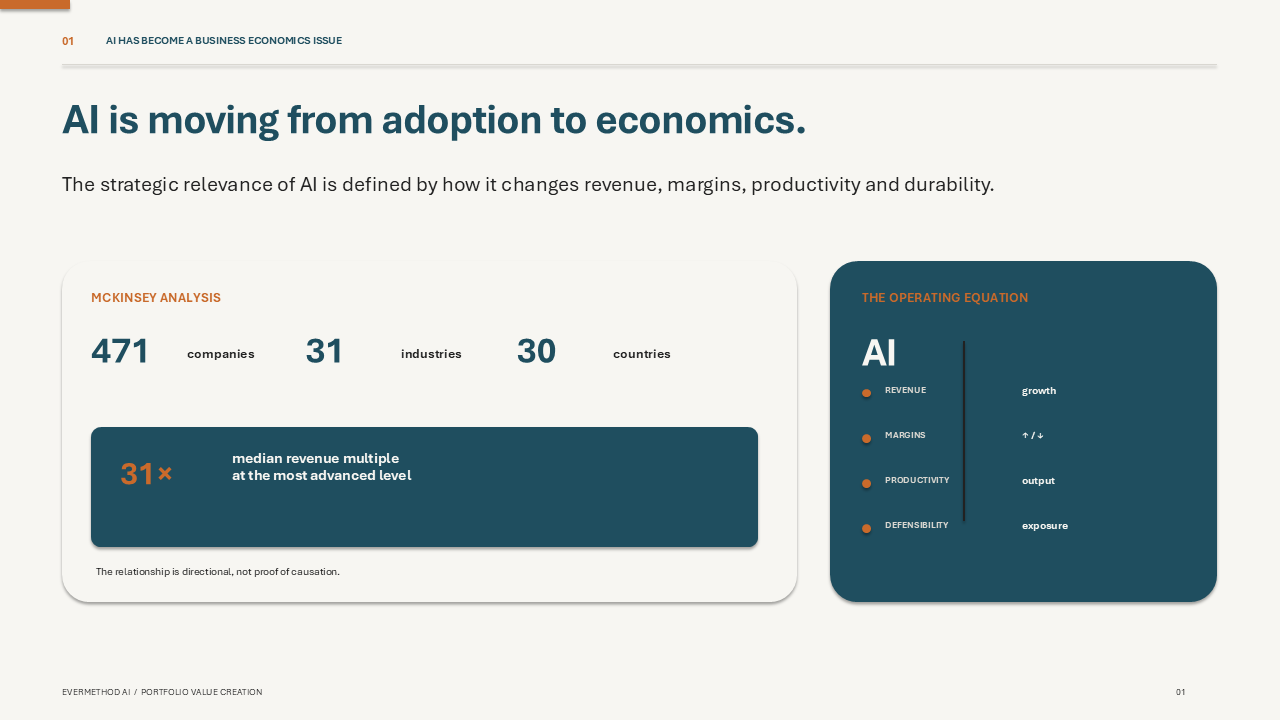
This is particularly relevant for private equity, where investment decisions are built around a relatively small number of fundamental drivers: revenue growth, margins, productivity, competitive position and the durability of the business model. AI can influence several of these simultaneously. It can lower the cost of serving a customer, increase revenue generated per employee, accelerate product development or make an existing source of differentiation less defensible.
The implication extends beyond private equity. Any leadership team responsible for portfolio performance, capital allocation or enterprise value increasingly needs a way to understand where AI creates opportunity and where it creates exposure.
1. AI Has Become a Business Economics Issue
The first wave of enterprise AI was largely about experimentation. Companies introduced copilots, automated individual processes and gave employees access to generative AI tools. Those initiatives helped establish where the technology could improve day-to-day productivity.
The next phase is more consequential because the discussion is moving from adoption to economics.
McKinsey's analysis of 471 private equity-backed companies across 31 industries and 30 countries illustrates the difference. Companies at the most advanced level of AI adoption in the study had a median revenue multiple of 31x, compared with 20x at the preceding level. Median revenue per employee also increased from $118,000 to $180,000. The research does not establish that AI alone caused those outcomes, but it does show that companies embedding AI more deeply into operations, products and new business initiatives can exhibit materially different economic characteristics.
That distinction matters. The value of AI is unlikely to be captured simply by counting licences, pilots or automated workflows. Its significance becomes clearer when it changes one of the economic assumptions behind the business.
A software company may be able to develop and support its product with a different cost structure. A professional services business may increase revenue per employee without expanding its workforce at the same rate. A B2B company may use AI to improve customer retention or deliver a service that was previously too expensive to provide. At the same time, a product that once had a strong technology advantage may become easier for competitors to replicate.
AI therefore belongs in the same strategic conversation as pricing, commercial effectiveness, operational efficiency and product strategy. It is increasingly part of understanding the asset itself.
2. Adoption Does Not Automatically Create Value
There is already plenty of evidence that AI adoption is moving faster than measurable financial impact.
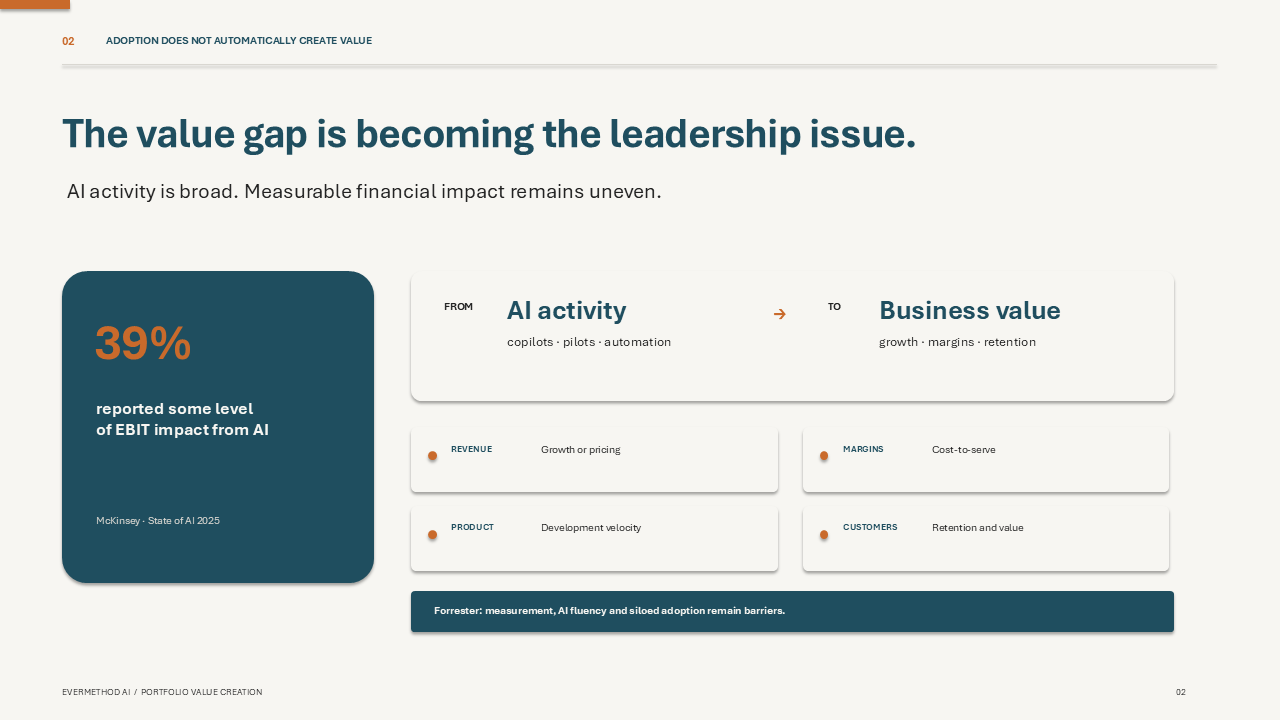
McKinsey's 2025 State of AI research found that 39% of respondents reported some level of EBIT impact from AI, while most of those respondents said the contribution was less than 5% of EBIT. The numbers suggest that organisations are finding practical uses for AI, but the financial effect remains modest for many businesses.
Forrester has identified a related problem. Many enterprises are struggling to convert AI adoption into measurable business value because initiatives remain focused on technology or isolated productivity improvements rather than broader business transformation. Its research also points to challenges around measuring impact and coordinating adoption across organisational silos.
For senior leadership, this changes how AI should be evaluated.
An AI initiative should have a clear relationship with the economics of the business. Management should know whether the intended outcome is higher revenue, better margins, lower cost-to-serve, faster product development, improved retention or a change in the company's competitive position. The investment can then be evaluated against the same commercial discipline applied to other major value-creation initiatives.
This is especially important at portfolio level. A portfolio can accumulate dozens of AI experiments while creating very little incremental enterprise value. The more useful approach is to identify the relatively small number of opportunities that can materially influence the investment thesis and then track whether those opportunities are producing the expected results.
That is where AI moves from being an innovation topic to becoming part of portfolio value creation.
3. The Emergence of the AI Operating Partner
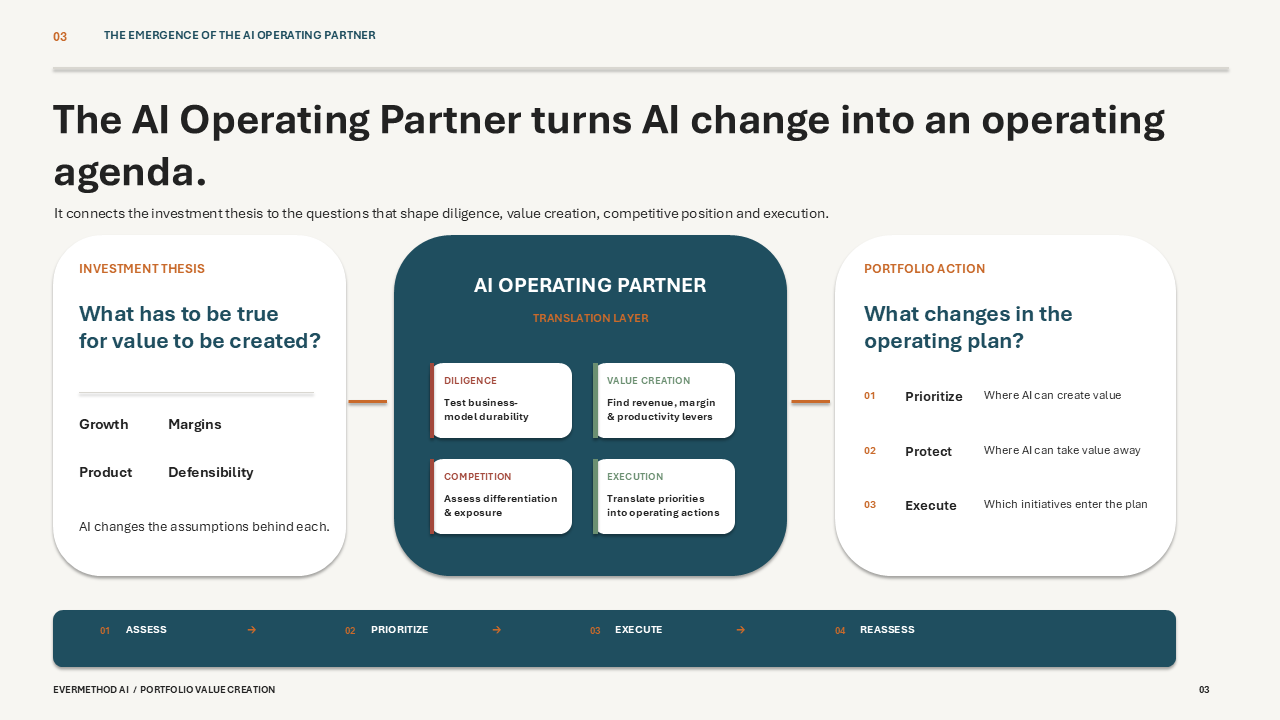
The traditional operating partner exists to help translate an investment thesis into operational action. The emerging AI Operating Partner extends that role into an area where technological change can increasingly alter the assumptions behind the thesis.
The role is not primarily about choosing AI vendors or managing technology projects. It is about understanding where AI intersects with the business and bringing that understanding into decisions about growth, cost, products, customers and competitive advantage.
Consider a software business whose engineering team becomes substantially more productive through AI-assisted development. The immediate benefit may appear to be an engineering cost reduction. The larger opportunity could be faster product releases, a broader product roadmap or the ability to serve a larger customer base without a proportional increase in headcount. Similarly, AI may reduce the cost of delivering a service, but that does not automatically translate into higher margins if competitors can adopt the same capability and pricing pressure follows.
These are business questions, not technology questions.
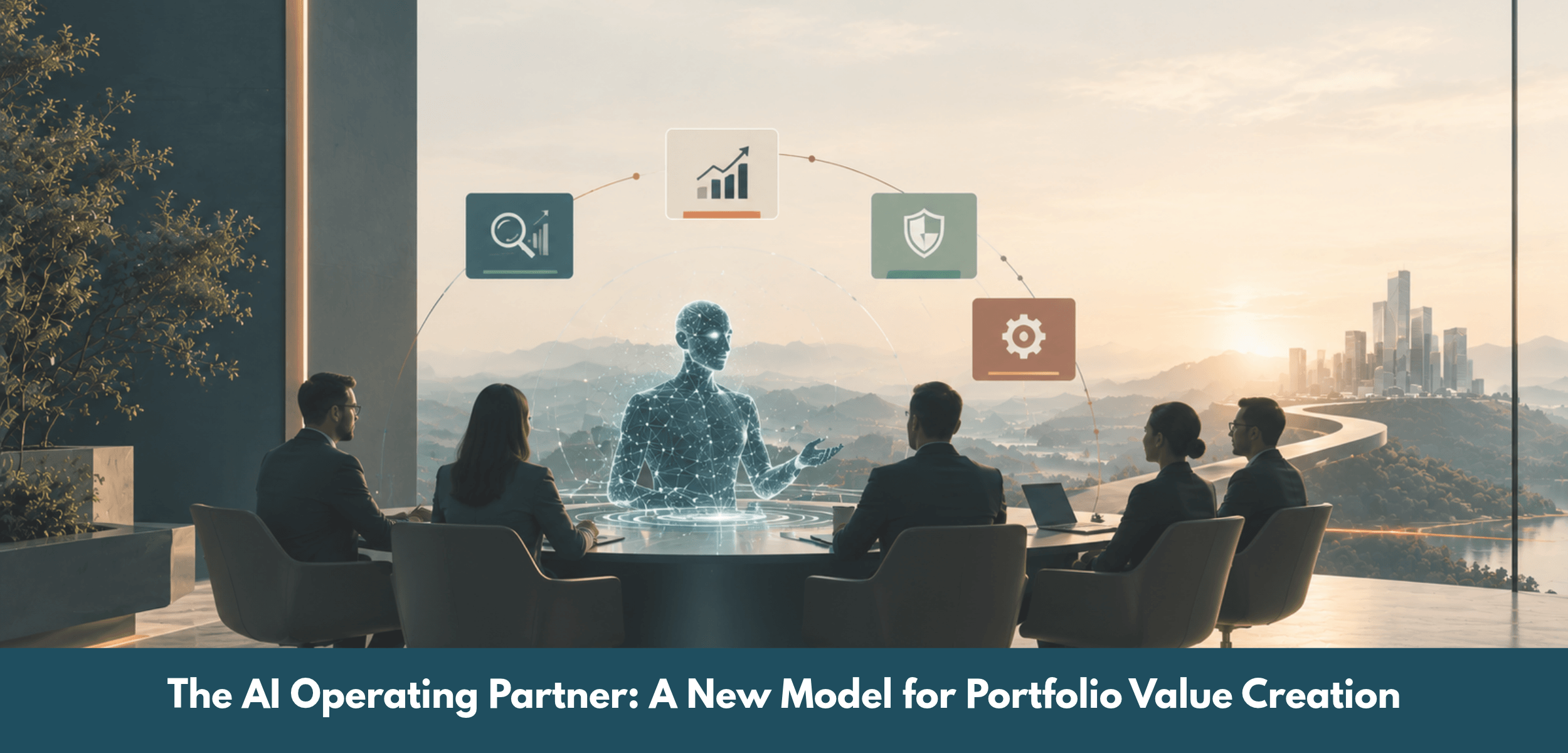
The AI Operating Partner provides the connection between the technology landscape and the value-creation agenda. During diligence, that means assessing how AI could affect the durability of the business model. After acquisition, it means incorporating the relevant opportunities into the operating plan and revisiting the assumptions as the technology and competitive landscape develop.
At portfolio level, the role can also create institutional knowledge. Lessons from one company can inform another. Emerging risks in a particular sector can be identified earlier. Successful approaches can be shared without forcing every portfolio company to start from scratch.
The result is not another layer of technology management. It is a more informed approach to value creation.
4. AI Exposure Is Part of Understanding the Asset
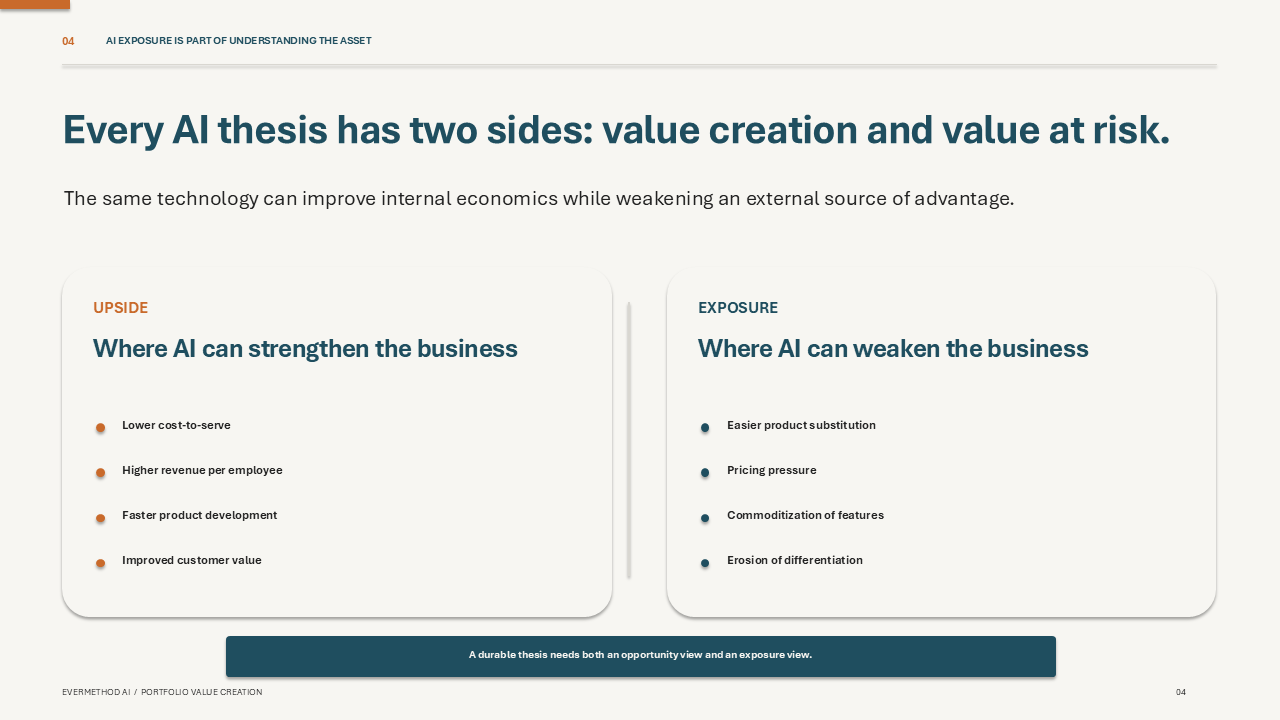
The opportunity created by AI is only half of the equation. The other half is exposure.
A business may benefit from AI internally while becoming more vulnerable externally. A company could improve its margins through automation at the same time that an AI-native competitor makes part of its product easier to replace. A software provider may introduce powerful AI functionality, only to discover that customers increasingly expect those capabilities to be standard rather than differentiated.
For that reason, AI assessment should look beyond productivity.
A useful review considers the effect AI could have on revenue growth, gross and EBITDA margins, revenue per employee, customer retention, cost-to-serve and product economics. It should also consider whether AI strengthens or weakens the company's competitive differentiation and whether the underlying advantage is likely to remain durable.
This perspective is particularly important during a holding period because the competitive environment can change faster than the original investment thesis anticipated. A capability that looks distinctive at acquisition may become widely available two years later. Conversely, a company that initially appears exposed may develop a stronger position by using AI to improve its product or operating model.
AI exposure is therefore not a one-time diligence exercise. It is something that needs to be reassessed as the technology, customer expectations and competitive environment evolve.
5. Building AI Into the Next Generation of Portfolio Value Creation
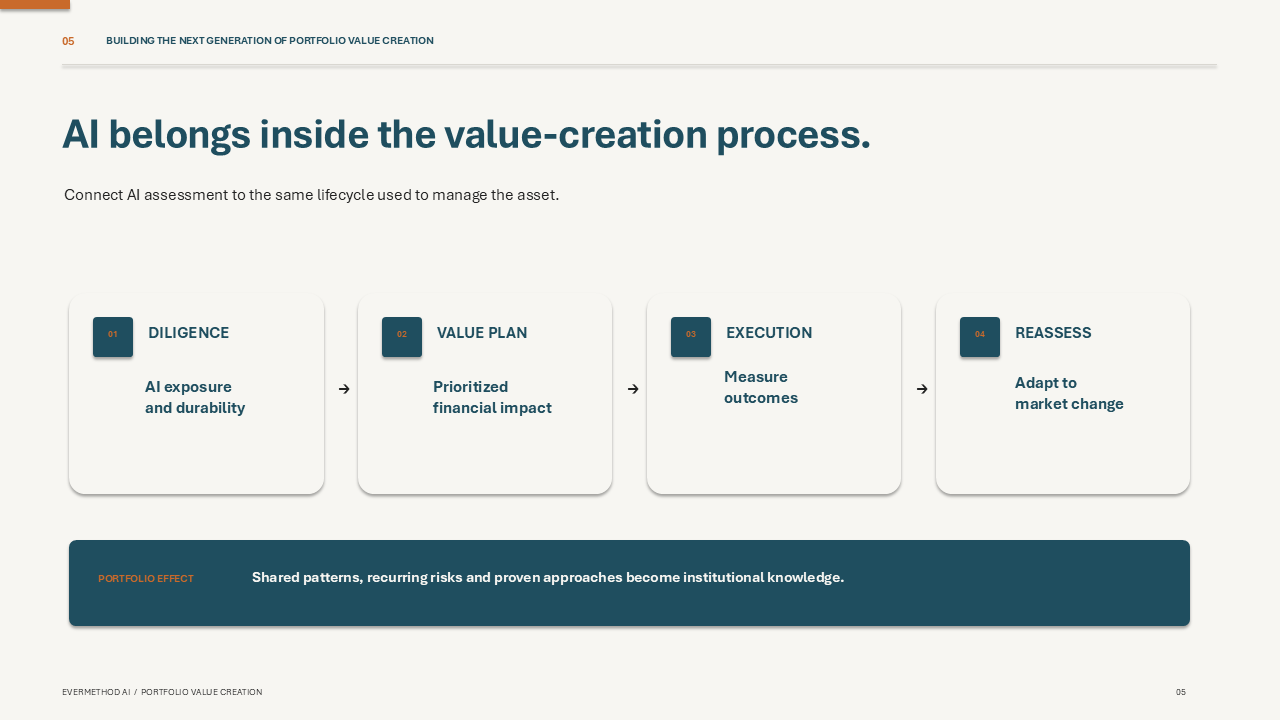
The emergence of the AI Operating Partner does not require organisations to replace their existing value-creation models. It requires them to extend those models to account for a technology that can affect several drivers of enterprise value at once.
The practical starting point is straightforward. During diligence, leadership and investment teams should identify where AI could strengthen the business, where it could weaken existing advantages and which assumptions in the investment case are most exposed to technological change. Those findings can then become part of the 100-day plan, operating agenda and ongoing portfolio review rather than remaining in a separate technology assessment.
The discipline is ultimately about connecting technology to outcomes. The number of AI tools deployed is less important than whether the business is becoming more productive, more profitable, more differentiated or more resilient as a result.
This is also where portfolio-level thinking becomes valuable. An investment firm or corporate group with multiple businesses can build a common view of AI exposure across its portfolio, identify recurring patterns and share lessons between companies. Over time, that becomes an organisational capability rather than a collection of disconnected AI projects.
For boards, CEOs, investors and operating leaders, this represents a broader shift in how portfolio value creation needs to be considered. AI is no longer simply something the technology function needs to monitor. It can influence the assumptions behind growth, margins, productivity and competitive advantage, which means it belongs much closer to the centre of strategic and investment decision-making.
From AI Awareness to Action
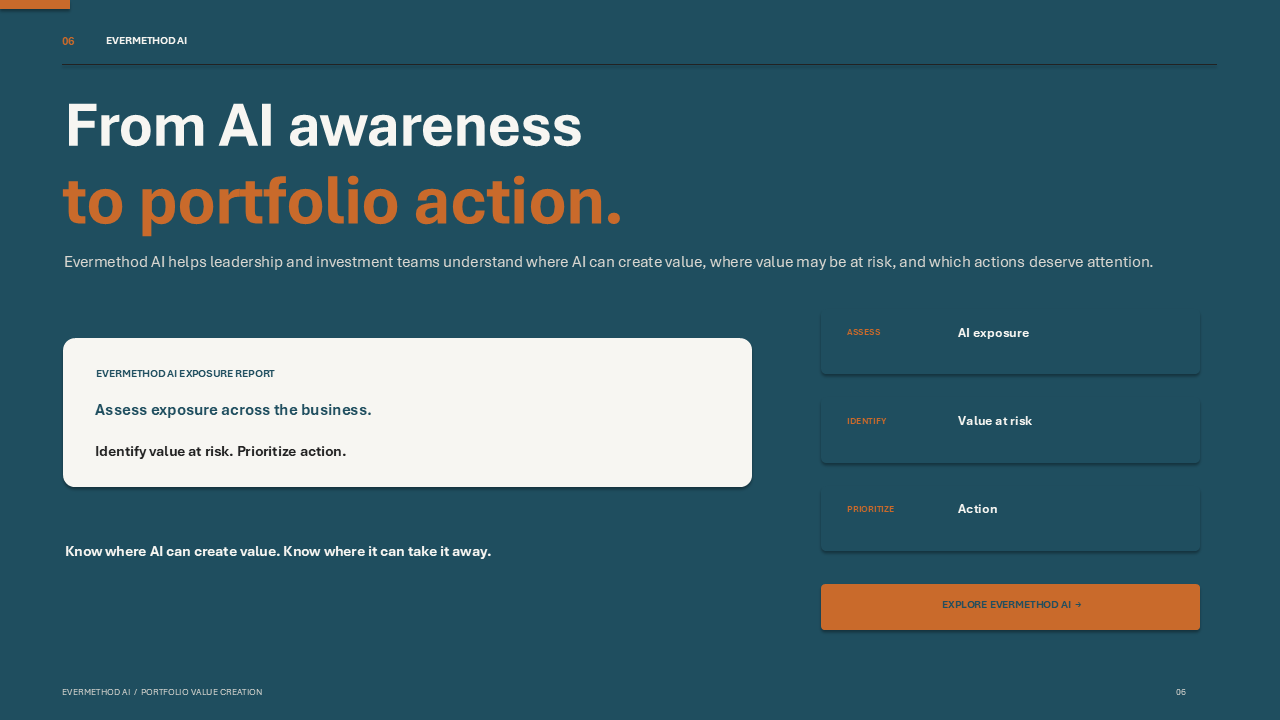
The next step is not to launch another AI initiative. It is to understand how AI could change the value of the businesses you are responsible for, where the greatest opportunities sit and which parts of the existing value-creation thesis may be exposed.
That assessment matters before AI-driven change becomes visible in financial results or competitive pressure. By then, the available options may be narrower and the cost of responding may be higher.
Evermethod AI helps investment and leadership teams make that assessment.
Evermethod AI evaluates how AI could affect a software business across its products, operations, customers and competitive position. It identifies potential areas of disruption, assesses the strength of existing defensibility, highlights potential value at risk and helps leadership teams determine where deeper analysis and action should begin.
Know Where AI Can Create Value. Know Where It Can Take It Away.
Assess your portfolio's AI exposure before the market does it for you.
References
- McKinsey & Company — Beyond Productivity: How AI Creates Value in Private Equity
- McKinsey & Company — The State of AI in 2025
- Forrester — Three Years Into GenAI, Enterprises Are Still Chasing Its True Transformative Value
- Harvard Business Review — How Private Equity Firms Are Creating Value With AI
- Forbes Technology Council — Private Equity’s AI Imperative: Turning Algorithms Into Alpha
%2013.png)
-1%20(1).png)